- Key insight: Uncover how Intuit is enabling accountants to turn standard operating procedures into agents.
- What’s at stake: Firms that bill by the hour as automated workflows complete tasks in nanoseconds
Intuit showcased its latest technology for accountants during the second day of its Intuit Connect conference in Las Vegas, along with a conversation with an Oscar-winning actress.
Processing Content
Among the
“Agent Studio allows you to capture decades of your expertise, your standard operating procedures, and to use natural language to actually turn it into an agent,” said Intuit executive vice president and chief technology officer Alex Balazs during a presentation. “That’s good. What’s great is that you get to decide where human judgment comes in.”
Diana Williams, vice president of product for accountants at Intuit, showed off the new Playbooks feature in Accountant Suite.
“With Playbooks, you can author your chart of accounts as well as your closed processes into reusable templates,” she said. “You can deploy them across your firms and clients.”
Intuit is rolling out new features even as they’re still in development, but is now labeling them as Pilot, Beta and GA for when they’re generally available.
“My personal commitment to you is that every time we release a new experience, a new innovation, we’ll let you know,” said Balazs.
Accountants will also have more control over which features are available to their team in Enterprise Suite.
“We’re now putting control over experiencing new features in your hands with our new early access program, built right into the product,” said Wyatt Jenkins, senior vice president of product for the midmarket group at Intuit. “You can just log in. You can decide that you and your team want to access those new pilot and beta features. You also have permissions, so you can control who in your organization has access to those new experiences. That way, we’re putting it back in their hands.”
Accounting firms can use the Playbook tool to create a customized version of Intuit Enterprise Suite, preloaded with all the client’s data. Intuit is rolling out industry-specific versions of Enterprise Suite, starting with the construction industry, which launched in February, to be followed by not-for-profits and manufacturing.
Meeting accountant demands
Intuit is also working to meet accountant demands by speeding up page load times in QuickBooks and adding other efficiencies.
“We know your time is valuable, so just as we’ve done with Intuit Accountant Suite, we’ve invested in performance improvements in QuickBooks, including faster homepage load times and more reliable bank connections,” said Arundhati Singh, senior vice president for small business and accountants at Intuit. “We’re also investing in improvements that help you stay organized and in control. Take account blocking as just one example. You’ve all felt the frustration of having a transaction accidentally post to the parent account instead of the appropriate subaccount. Well, now with just a single click, you can lock that parent account to prevent the unlocked posting in the first place, and now you and your client can create QuickBooks invoices, directly in Claude and ChatGPT from live customer data.”
A new chart of accounts feature in QuickBooks can help firms onboard new clients who have had problems in the past with their accounting.
“Onboarding a new client is exciting and rewarding, but you all know that new clients often come with a little gift called ‘you might need help clean up their books,’ and so we’re introducing the new agentic chart of accounts cleanup workflow in QuickBooks that was designed in partnership with accountants to make it easier to get through the cleanup, so you can get them guidance and advice faster,” said Singh.
Last week, Intuit acquired Sequence, an AI-native revenue management platform. “The Sequence team created an agentic platform that replaces spreadsheets and manual billing workflows from contract to billing to invoicing and rev rec, end to end,” said Balazs.
Building AI across the board
Intuit is adding new AI features across its product lines. “We’re really investing in transforming all three product experiences, so that small businesses, midmarket businesses and the accountants and firms that advise them are able to free up their time, have confidence in the automation of manual work, and that confidence piece is incredibly important,” said Ashley Still, executive vice president and general manager of the small business and midmarket group at Intuit, during an interview. “Then of course get faster to the insights and the intelligence, which is what the reward is.”
While Intuit is integrating its products with outside AI systems, it’s still letting users work within the familiar confines of QuickBooks and its sister products. “Of course we support third-party AI experiences and AI chat like Claude or ChatGPT or Gemini,” said Still. “We also have our own conversational experiences, and we want businesses to have a great experience, to get the results that they can trust. Whether you’re actually asking directly within QuickBooks or Accountant Suite, or whether you’re using a Claude or a ChatGPT, that difference is really just about user preference. What we find is actually a lot of small businesses and firms actually prefer to stay in the Intuit environment.”
She recently talked to a large firm that said it already had security approval for Intuit, but going outside of the platform to build agents for automation would create governance issues.
Users are growing more comfortable with using the features in Intuit’s systems that already act like AI chatbots. “We’ve doubled the amount of engagement, the number of prompts, just quarter over quarter, which is great,” said Still. “We’re seeing a lot more comfort using the experience within QuickBooks, and then of course we’re also seeing a lot of growth in engagement through Claude and OpenAI. Everything is growing fast in terms of engaging with conversational experiences.”
However, accountants are still cautious about sharing their clients’ information with widely used AI systems and prefer to keep it within the Intuit environment. During a later panel discussion, Still asked a group of accounting firm owners about their experiences with AI.
“The hardest question I’ve gotten in the past couple months is, can AI do that?” said Hector Garcia, a CPA who runs a seven-person team in Miami. “I’m in the middle of presenting our services. We have this incredible presentation done by AI, where we’re saying we’re going to reconcile this, and we’re going to trend analysis this, and we’re going to advise you on that, and we’re going to tax plan that. And here’s the price. And the client goes, ‘Can AI do that?'”
It’s a very difficult question. Can AI do that? The answer should be, ‘I sure hope so,’ because the value we create cannot be identified by the amount of effort that we put in. If we try to bill by the time that AI takes to do stuff, we’re going to have to bill by the nanosecond.”
Nicole Davis, managing partner of Conscious Accounting in the Atlanta area, mostly works with healthcare companies, construction and service-based professionals.
“AI allowed me to rediscover something, and that was my why,” she said. “For a lot of us here, we didn’t get into accounting because we wanted to reconcile these accounts and print out tax returns. My dad owned an auto repair shop. He was a small business owner, and he was a really good mechanic, but he was terrible at business. I remember working in my big corporate accounting job, very stuffy, in my little cubicle, and I sat back and thought, wait, I can sit here and help big companies get bigger, or I can use what I know and help people like my dad get better. For me, I think AI is going to help us rediscover our why. It’s going to give us that time back to reimagine and go back to why we actually got into this industry in the first place.”
Roman Villard, founder of Full Send, said his firm in Boulder, Colorado started as a CAS practice doing outsourced accounting, and then brought on a team of data scientists that understand data architecture, data cleanliness and data visualization.
“When we started that service, AI wasn’t a big part of the conversation,” he said. “But when you have a good perspective on a variety of data sources, how those come together, how it should be cleansed, you can now do a lot more with that structuring in order to adopt AI. That service line has really transitioned from pure data into now AI consulting and agentic activity with our clients, building custom applications. It takes a very specific mind to do that. I believe accountants are data analysts by nature. We are all transacting data, we’re cleansing it, we’re reconciling it, we are visualizing it, and reporting for our clients. We have this capability, and that’s how it’s evolved for us over the last few years.”
Matthew May, national CAS managing partner at Sorren, a Top 50 Firm in Meridian, Ohio, said he initially feared AI would take away accounting jobs. But another person told him to imagine what the data could do for clients. “The person looked at me and said, ‘Stop! You’re thinking about this wrong. You’re thinking of this as a zero-sum game.’ He said, ‘We’ve never had this much data in front of us to be able to help our clients for, and we’ve never even imagined what we could do if we had this data and how we help our clients.'”
From stage to screen
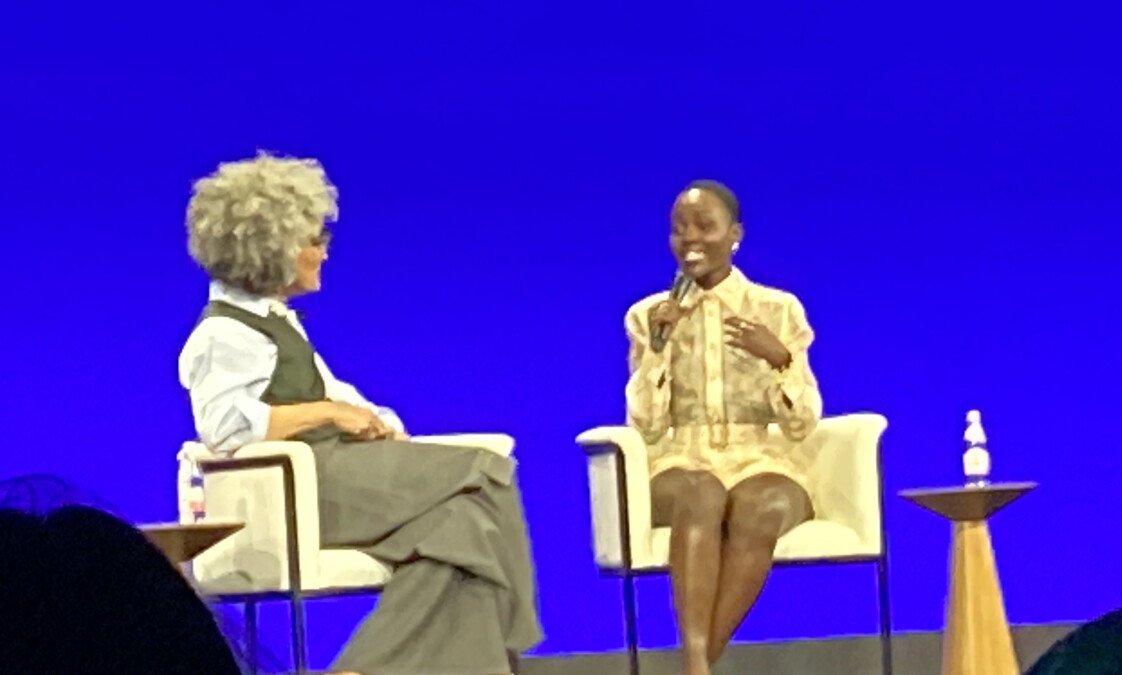
Oscar-winning actress Lupita Nyong’o ended the day in a conversation with Carla Hall, star of the cooking competition show, “Top Chef.” Nyong’o discussed her roles in films such as “12 Years a Slave,” for which she won the Academy Award, as well as more recent roles in films such as “The Odyssey,” “Black Panther,” “Black Panther: Wakanda Forever,” “Us,” and the play “Eclipsed.”
“The things that I think about in choosing a role, I ask myself these questions: Is it interesting? Because if it doesn’t hold my attention, then how will it mold anybody else’s? And I have to read that script very many times,” she said. “And then I ask myself, is it entertaining? Because obviously, what I do is meant to give people a respite from their lives and hopefully make their lives brighter or inspired in one way or another. Another question I ask is, is it meaningful? Because every role that I take, I am giving it my lifetime, so I don’t want that time back. So I want to do roles that move the needle, and it can be as meaningful as ’12 Years of Stave’ that tells a story of the history of slavery in this country, and or it can be as silly as ‘Little Monsters,’ which is really just a small indie film I did that is just raucous and funny. But I want it to move whatever I’m doing, and then I also ask myself, what will it teach me? My job allows me to learn so many skills. I learned how to free dive for ‘Wakanda Forever.’ I got over my fear of cats for ‘A Quiet Place: Day One.'”
Beyond the film and stage, she has also been hosting a podcast called “Mind Your Own,” a storytelling podcast from an African perspective, and wrote a children’s book, “Sulwe,” inspired by her own experiences growing up in Kenya. She also developed an animated series, “Super Sema,” whose superpower is STEM.
“I was not very good at math, but this little girl makes STEM fun, and the people behind it really wanted to inspire children, African children, especially girls, to embrace science and math and so on,” said Nyong’o. “When I saw it, I was like, ‘Oh my God! If I had had this as a child, I’d have been so much better in math.’ I’m certain of it because when you’re able to see someone like yourself doing something unimaginable, something that feels so far out of reach, it becomes that much more doable to you, and the way in which they do it is universal. It’s in that specificity of the little girl being from Kenya that captures children’s imagination.”
Nyong’o recently took on a new path by becoming a part owner of the Nairobi City Thunder, a basketball team in Kenya, but only after doing extensive research.
“I was able to talk to incredible basketball coaches in the NBA, and I just used my networks to really try and understand what it means to be an owner, and what is the risk involved?” she said. “And the one question I ask myself is: If I get involved once I’ve done the research, and I now have some semblance of an understanding, I ask myself why I’m doing this. And for me, it was that I felt like I wanted to be a part of that, invigorating my community in Kenya with sport. And then I asked myself, if it doesn’t work out, if it fails, will it have been worth it? And the answer was, yeah, I’m willing to risk that.”
Introductory bullet points created by AI with editorial review.