


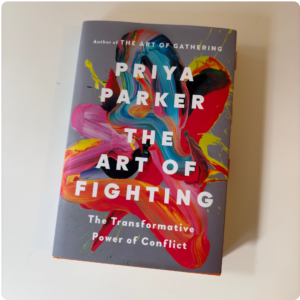
I am currently reading The Art of Fighting by Priya Parker* with my book club. The book is about conflict in groups. That interested me, because most books about conflict and communication are about one-on-one situations. And as an internal martial artist myself, the title made me curious, too.
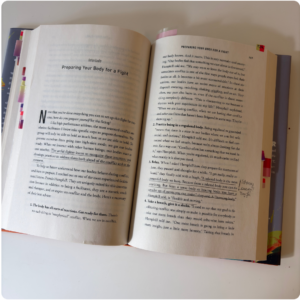
Then I was surprised to find a section that felt so much like Taijiquan. It’s about preparing your body for a fight, and it touches on several aspects of Taijiquan.
How to prepare your body for a fight
Priya Parker writes that experienced conflict facilitators prepare themselves much like high-performance athletes. For example, she asked Prentis Hemphill, a facilitator, somatic coach and therapist who works with conflict and the body. Here is their list:
Preparing your body for a fight
1. The body has all sorts of reactions. Get ready for them. (…)2. Practice being in a regulated body. (…)
3. Relax. (…)
4. Take a breath, give it a shake. (…)
All of that makes sense generally. And all of it is something we do in Taijiquan. But what really stood out to me was the exact wording of point 3.
A relaxed body is the most powerful body
Taijiquan is often not seen as a martial art, because it is so slow and relaxed. So I was fascinated when I read how Hemphill talks about relaxing before a fight:
3. Relax. When I [Priya Parker] asked Hemphill how they prepare for moments of heat, they paused and thought for a while. “I get really, really relaxed,” they finally said with a laugh. “A relaxed body is the most powerful body we have. Because from a relaxed body you can do anything. But from a tense body or bracing body, you have a smaller set of moves you can make,” they said. A “listening body,” Hemphill said, is “flexible and moving.”
Wow, doesn’t that sound like a quote from a Taijiquan book? There are actually two things in this paragraph: being relaxed and having a listening body. In Taijiquan, we have names for both: Sōng and Tīng Jìn. Let’s look at them in detail.
Sōng: relaxation without softness
Being relaxed is what Taijiquan is all about. Even people who don’t practise Taijiquan know that. And that is exactly the core of Taijiquan: to stay relaxed and slowly drill the fight moves. The Chinese word for that is Sōng:
Song: relaxation, loosening, letting go of unnecessary tension.
However, being relaxed doesn’t mean being a couch potato. Actually, there is a more precise Chinese term: Fàng Sōng (literally “let go” and “loose”).
Fang Song: to loosen the body. Relaxation without softness.
So you want to be relaxed, but still keep your internal structure. It’s the same when you go into a fight: you want to be relaxed, but still have your values and your backbone.
Tīng Jìn: the listening body
The second part of the quote is about the “listening body”. In Taijiquan, that is Tīng Jìn, listening energy:
Ting Jin: the ability to accurately listen to/feel/interpret the energy and strength of another person.
This is a more advanced skill. Relaxation is something you can see immediately, even as an outsider. Listening is more subtle. You can feel and experience it in push hands or when testing applications. No wonder push hands is also called “listening hands”.
Listening to a partner’s energy in push hands is close to listening to the other person in a conflict.
Reading that part of the book made me wonder how I can bring Taijiquan principles even more into my daily life. Not only when I am physically moving, but also in conversations and conflicts with the people around me.
And to go even further, I started thinking about group conflicts in Taijiquan. We usually learn and practise in groups. There is sometimes tension between people. Actually, that is what my own novel Push Hands* is about: tension in a Tai Chi group.
So if you’re curious, give The Art of Fighting by Priya Parker* a read. And maybe think about the group conflicts you are in right now. How could you bring a little Sōng and Tīng Jìn into them?
Happy Qi!
Angelika