


Last Updated on November 13, 2026 by Kay
This post may contain affiliate links, meaning I may earn a small commission on any purchases through those links at zero additional cost to you. Whatever I make goes to keeping this website running and I am forever grateful for the support. See my Privacy Policy for more information.
My daughter started elementary school in Japan this year, so I thought I would share what the process was like and what I had to prepare ahead of time to help other parents out.
Choosing an Elementary School
There are private elementary schools as well as public schools. Most children attend a municipal public elementary school, which is assigned based on where they live. This is usually a school close to your home, although it won’t necessarily be the closest one since it’s assigned based on school districts.
You generally cannot choose which public elementary school your child attends, although some municipalities allow parents to choose between certain schools or request a different school under specific circumstances. This wasn’t the case for us.
If your child is attending a municipal elementary school, you’ll receive a school enrollment notification (就学通知書) in the mail, usually around January. This tells you which school your child will attend. Depending on your municipality, you’ll need to keep this document and bring it to the entrance ceremony in April. You don’t usually need to fill it out or apply separately to the school.
There are also national elementary schools, which are usually affiliated with universities. Unlike regular municipal elementary schools, these typically have an application and selection process.
You can also apply to private elementary schools or international schools, although admission isn’t guaranteed. Private elementary schools sometimes have entrance exams or interviews, and international schools have their own admission requirements.
Some private elementary schools are escalator schools, meaning they have affiliated junior high schools and high schools. One advantage is that children may be able to continue to the next school without having to take another entrance exam, although this depends on the school’s requirements.
I did consider a private elementary school associated with my daughter’s preschool, especially since I liked the idea of her not having to take entrance exams for junior high school or high school. However, it was quite expensive (I believe around 1 million yen a year). Hardly any of her preschool classmates were going there, either, so we chose public.
And so far, it’s been great! All the kids in our neighborhood go to the same school, and they walk to school together (and play together in the park after school).
If your child won’t be attending their designated municipal elementary school because they’re going to a private, national, or international school instead, you’ll need to inform your municipality’s Board of Education and submit any required documents. The procedures and deadlines vary by municipality, so make sure to check with your city or ward office.
Health Checkup
Elementary school in Japan starts in April. A few months before your child starts school, the Board of Education will send a health checkup notice to your home. Expect this around October to December.
This notice requires children to complete a health checkup at their designated elementary school on a specific date. My daughter missed hers due to travel commitments, so we ended up having to go to a health center to do it.
This is a standard health checkup that involves things like vision and hearing tests, and a general physical examination.
Orientation Session
At the beginning of the year (usually January or February), schools hold an orientation session for parents, typically on a weekday.
During this session, you’ll receive information about school rules, what a typical school day looks like, what supplies your child needs, and anything else you should prepare before April.
You’ll also receive a list of school supplies you need to buy. Make sure to read it carefully because some schools (like my kid’s) have very specific requirements about things like pencil shapes, stationery brands, etc.
I recommend bringing a pen and something to take notes with, since there can be a lot of information!
Buying a Randoseru
If you live in Japan, you’ve probably already heard of randoseru, the very expensive backpacks that are supposed to last all six years of elementary school. I’ve written an entire article about randoseru, including when to buy, so feel free to take a look!
Uniforms
Depending on the school, some kids have uniforms for elementary school. My daughter’s school does not, so she wears whatever she wants (however, sweaters with hoods are not allowed). She does have a uniform for PE class, though, which we bought through the school. An experienced mom friend recommended buying size 130 so it lasts longer, and it was thankfully not too big for my daughter.
Purchasing School Supplies
There will be a long list of things to purchase, which you should receive at the orientation session. Some are very specific in terms of brand, etc., so make sure you check carefully.
Names need to be on each item, including pencils and pencil crayons. You can purchase name stickers (名前シール) for these, which is what I did. You can also get some pencils that are engraved with your child’s name, which my daughter received as a present from our neighbor as well as from her preschool.
Here is everything we had to purchase for our daughter. You can purchase these at stationery stores or Amazon Japan. (I’ve found that Amazon Japan can be much cheaper.)
Odougubako (お道具箱)

Children keep their school supplies, like glue, scissors, pencil crayons, etc., inside this, which is then placed in their desk.
2B Pencils

My daughter’s 2B pencils needed to be hexagonal, so make sure you check your child’s supply list before you buy!
Find 2B pencils on Amazon Japan
Starch Glue

Purchase starch glue on Amazon Japan
Oil Pastels (クレパス)

My kid’s school was very specific and said we needed to buy CRAY-PAS only!
Purchase CRAY-PAS on Amazon Japan
Ruler (定規, jyougi)

Purchase a ruler on Amazon Japan
Pencil Box (筆箱, fudebako)

My daughter’s school wasn’t very strict about what we used for a pencil box, so we got this standard type. (I remember being fascinated by these when I was a kid in Canada, so it’s exciting that my daughter has one now!)
Purchase a pencil box on Amazon Japan
Pencil Crayons (色えんぴつ, iro enpitsu)

Purchase pencil crayons from Amazon Japan
Scissors (ハサミ, hasami)

Purchase scissors on Amazon Japan
Eraser (消しゴム, keshigomu)

Pencil Board (下敷き、shitajiki)

Purchase a pencil board on Amazon Japan
Indoor Shoes (上履き, uwabaki)
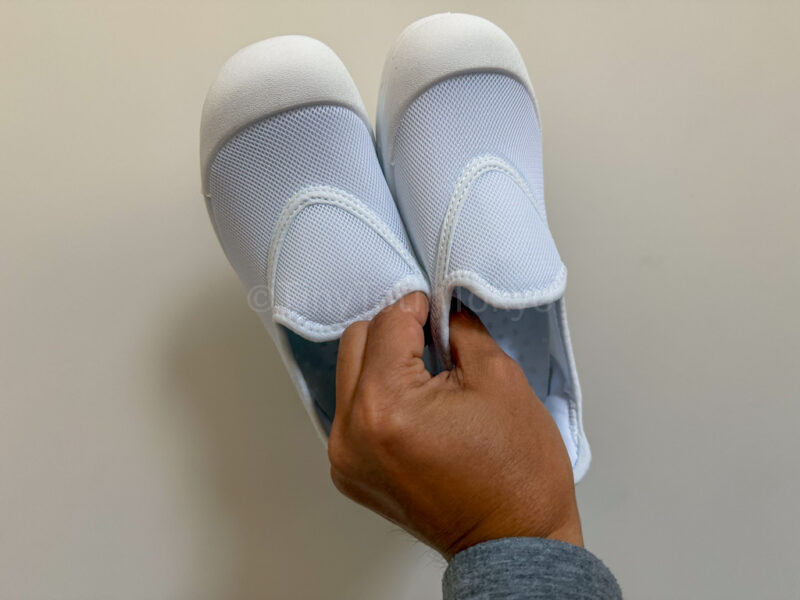
Purchase indoor shoes on Amazon Japan
Bag for indoor shoes

Purchase a bag for shoes on Amazon Japan
PE Clothes Bag (体操服袋, taisoufuku bukuro)
Purchase a PE Clothes bag on Amazon Japan
Emergency hood (防災頭巾, bousai zukin)
Purchase an emergency hood on Amazon Japan
Lunch Goods
Things my daughter needed for lunch were:
Optional (but recommended)
We got a GPS tracker for our daughter called みてねみまもりGPS トーク(Mitene Mimamori GPS Talk). This tracker allows us to check where she is at all times via an app, and she can send us voice messages. We have to pay a monthly fee for this.
We also let her get a kids’ keitai (mobile phone for kids) halfway through the school year. We bought it from AU. There is no internet on it, so she can’t watch videos or access weird websites. There’s an option to add GPS, but since we have the Mitene tracker, we felt no need for it.
Which is better? Well, most of my mom friends use the Mitene GPS only. My daughter prefers the kids’ keitai because she can take photos and send text messages to us, including stickers. I also like that I can call her. Sending messages via Mitene is fine, but my daughter doesn’t always notice since it’s so small.
The detailed GPS tracker in Mitene is amazing, though!
I think it’s best to start with the Mitene tracker and then go from there, especially since kids are not allowed to use phones in school. (My daughter only uses hers when she finishes school.)
Setting Up After-School Care
If both parents work, you might want to consider putting your child in after-school care. This is called either gakudo (学童) or ikuseikai (育成会). This is typically for parents who are working at least three days a week. For my daughter’s school, we needed to apply by January. This varies according to the school, so contact your child’s school as soon as possible to find out when you should apply.
You’ll need to submit various documents proving your employment. Since I’m self-employed, I was required to submit tax forms as well.
My daughter is in ikuseikai. At her school, there are four ikuseikai classes, and kids from grades 1 through 6 are mixed together. Unfortunately, my daughter hasn’t really made friends in her ikuseikai class, so she’s not a fan.
Kids can walk home together in a group from ikuseikai when it ends, just like they do in the morning when they go to school.
Entrance Ceremony
The entrance ceremony (入学式, nyugakushiki) for elementary school is held in early April. Everyone should be in formal wear. A suit for both mom and dad is perfectly fine. If you wear a dress, make sure it has sleeves or has a jacket paired with it.
This is what my daughter and I wore to the entrance ceremony:
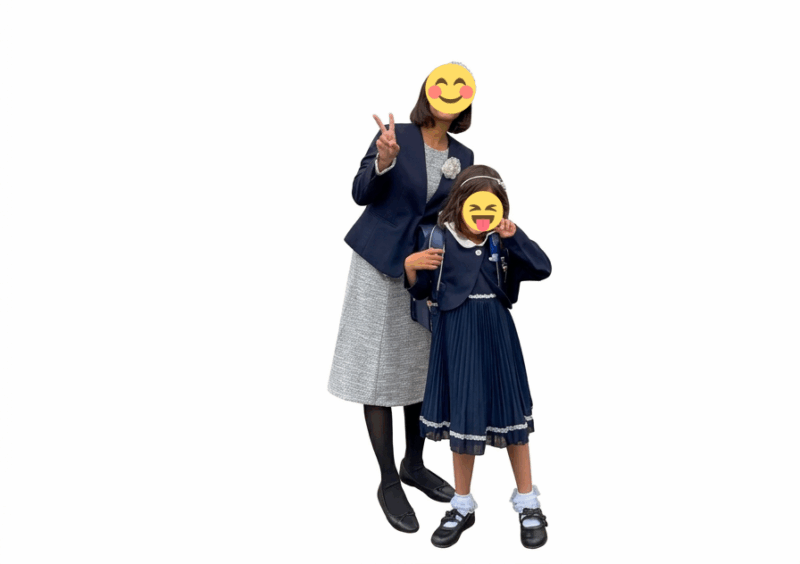
Children should also be in “ceremony” wear. They sell these types of outfits at stores like AEON Style and anyFAM. You can also find them on Amazon Japan. Here is the link for girls, and here is the link for boys.
Both parents typically attend the entrance ceremony, so make sure to request a day off work well in advance. Depending on the school, you may or may not be able to invite grandparents or other siblings; it really depends on how much space they have.
Don’t forget to bring any paperwork you need to submit, and make sure you have a bag large enough for any additional paperwork you need to bring home. Bring indoor slippers and a bag to put your outdoor shoes in. Make sure your child has their indoor shoes as well (上履き, uwabaki).
We brought our daughter’s school supplies, too, since she would be visiting her classroom for the first time on that day.
During the entrance ceremony, parents sat in the gymnasium and listened to speeches about the school, etc., while the children went to their classrooms. In the beginning, kids were brought out one class at a time and sat in front of everyone while the teachers were introduced. They then went back to their classroom while we parents had to listen to more speeches.
FAQ
Do kids need to attend Kumon or know basic hiragana etc., before starting elementary school in Japan?
Kids will learn basic hiragana from scratch when they start elementary school in Japan. However, to make things easier, your child should know how to write their name at least in hiragana.
Many children learn at least hiragana in preschool and daycare in Japan, so I think it’s best that your child knows it before they start school. This way, they won’t be behind. My daughter started learning basic kanji halfway through her first school year.


