

In South Africa, the unemployment rate is around 33%. For people under 36, it’s even higher — almost 50%. Despite this, many young people are avoiding hands-on trades, like welding and plumbing, and opting for a university education.
Sitara Naidoo is a 16-year-old in Johannesburg. She went to the Educonnect Media Future Economy Career Expo to explore study options, walking around the tables and stands with her mom.
Naidoo is a few years away from graduating high school, and everyone is talking to her about her future.

Sixteen-year-old Sitara Naidoo contemplates her future study options at a career fair in Johannesburg, South Africa. Elna Schütz/The World
“They really just talk to us about AI a lot and how we will not have any jobs. It’s really weird,” she said. “I’d really like to do graphic design or animation, but again, AI is so scary. It just does everything.”
She is hearing more about how uncertain the future is, but still feels pressure to get a degree.
Many other students at the career fair are also set on higher education as their main, or only, option.
“University has been my straight goal. I do not want to do anything else. I want to further my studies,” Buhlali Mhluzi said. She is in grade 11, meaning she has one year left of high school. She is interested in logistics, forensic accounting or criminology.
Mpho Nomandela from Soweto is also reluctant to study a trade. “I would go to university,” she said. “Times are tough now, and we need to have a better future and choose something that you know will get you a better job.”

Students at trade schools frequently already work as apprentices in their chosen field while training towards their trade tests. Elna Schütz/The World
There’s a clear preference for university degrees and the belief that they automatically lead to stable, better-paying, higher-status careers.
This is also true when a student’s first choice isn’t possible. For instance, Nomandela had hoped to go into corporate law, but realized at the career fair that she couldn’t apply because she takes mathematical literacy, not pure mathematics.
Several other students at the fair said they had their hearts set on a certain degree, but when they realized they didn’t have the right grades or subjects to pursue it, they immediately looked at unrelated degrees they might be qualified for, even if the career didn’t appeal to them as much.
Any other path seems far from their mind and this has been a long-standing trend.
“Vocational education in South Africa has been stigmatized since the early 20th century, when it was literally [used] to deal with juvenile delinquents,” said Stephanie Matseleng Allais, a senior researcher at the Centre for Researching Education and Labour, at the University of the Witwatersrand.
Allais explained that the history of technical and trade training institutions in the country is long and difficult. Numerous policy decisions have tried to reform the system and improve its image.

Students at the Artisan Training Institute go through self-led activities on mock electrical distribution boards. Elna Schütz/The World
But especially since South Africa’s transition to democracy 30 years ago, students have opted for the perceived success and prestige of university degrees.
“Universities expanded drastically and university enrolments increased very dramatically in the last 30 years, and that has certainly not helped us to rebuild or to build our vocational education pathway,” Allais said.
But success hasn’t always followed. Students struggle to afford going to university, and not everyone lands a high-paying job when they finish.
Allais says that the way to encourage students to pursue trade schools may be to not push trades as a large-scale solution to South Africa’s critical unemployment levels. Instead, focus on promoting trades as a smaller, high-quality option.

A student practices welding at the Artisan Training Institute, which has seen an increase in female students over the last few years.Elna Schütz/The World
“One of the things that we’ve done wrong is trying to make it a mass system, and the economy actually doesn’t really need a mass system,” she said.
“The economy needs high-quality, well-trained trades workers, and those people do get jobs. But I don’t think there’s really evidence that this could be a mass employment route.”

Boiler making and welding are just some of the many practical trades that students at the Artisan Training Institute study. Elna Schütz/The World
There are 50 public Technical and Vocational Education and Training (TVET) colleges in the country, plus around 150 private institutions. The TVET colleges enroll about 560,000 students. Nationwide, roughly 2.1 million students go into any kind of post-high-school education each year.
“I’ve seen too many youngsters out there sitting at [the] university for four years, seven years, getting out there and still not finding employment,” said Riaan van der Merwe, the campus manager at the Artisan Training Institute, a private trade school.

Campus manager at Artisan Training Institute, Riaan van der Merwe, is proud of the various trade skills on offer. Elna Schütz/The World
He believes that trades are hands-on skills that can be put to good use. “I always say to tradesmen, ‘Your family will never go without food at night. You will make a plan.’”
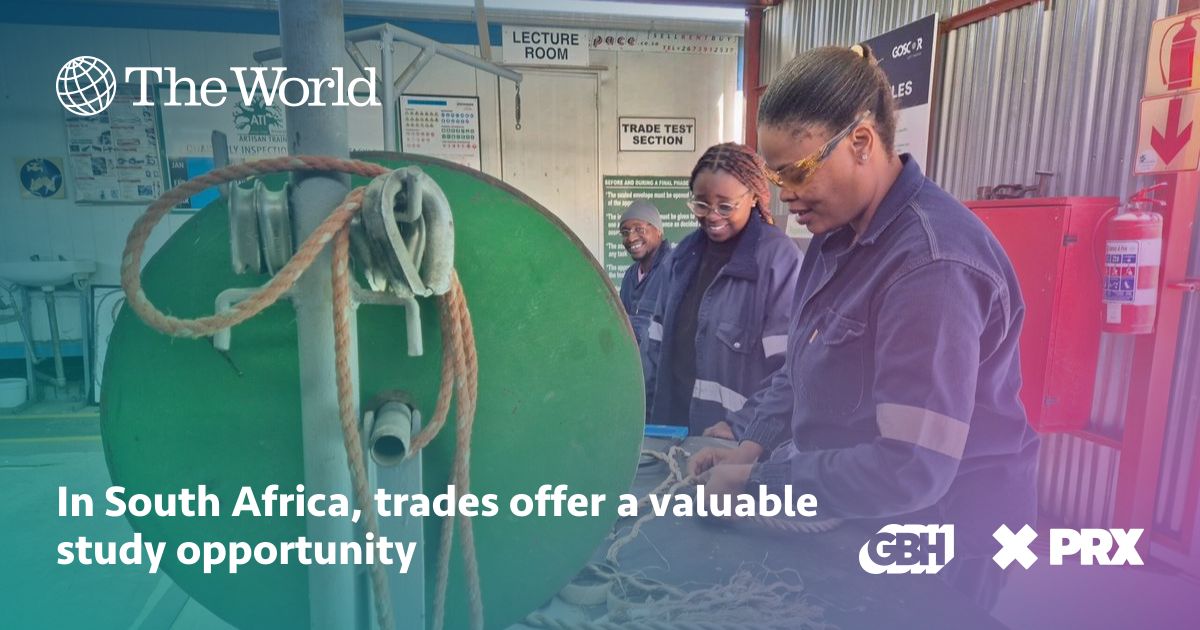
Students across campus are welding, fixing cars and working on electrical dashboards. The institute’s students are mostly already in a trade job or apprenticeship, and come for chunks of time each year to study and practice toward getting their qualifications to work on their own.
Van der Merwe says the institute is training globally competitive tradespeople who will be resilient to some of the coming challenges.

Students and trainers work closely together in the hands-on training in trades such as automotive mechanics. Elna Schütz/The World
“Everybody’s talking about AI taking over. I’ve never seen AI strip an engine and put it together again,” he joked.
For a lot of the students, like 21-year-old Damian Holiday, their choice of a trade wasn’t a particularly difficult or calculated one. He is close to becoming a qualified tractor mechanic and says it was an easy decision.

Damian Holiday says that studying to become a tractor mechanic was an easy choice to make. Elna Schütz/The World
“I’ve never been one for school or studying, so university wasn’t really in the question, or it wasn’t really a choice,” he explained. “I knew straight after school I wanted to start working with my hands.”
For people like Holiday, learning a trade, often while already earning an apprenticeship salary, makes the most sense. He wishes more people would appreciate the trades as an alternative to a university degree — a necessary and valuable alternative, at that.
“It’s not easy, and I think it’s a lot more important than people know, because if you don’t have mechanics working on the agricultural machines or the mining machines, none of those things would function properly, and I don’t think it would go well.”
In other words, as the joke goes, no matter how many people thrive in university-backed careers, even the president needs a plumber.