

The Timurid Period was a significant era in the history of Central Asia, Persia, and the Islamic world.
It began in 1370 when Timur, also known as Tamerlane, established the Timurid Empire.
Although Timur was a powerful military leader who expanded his empire through conquest, the period is best remembered for its remarkable achievements in art, architecture, literature, and science.
The Timurid rulers transformed their empire into a center of cultural and intellectual excellence, leaving a lasting legacy that influenced later civilizations.
Cultural and Artistic Achievements
The Timurid Period is often regarded as a golden age of Islamic culture.
Timurid rulers generously supported scholars, poets, scientists, and artists, encouraging the growth of knowledge and creativity.
Persian literature flourished, and manuscript production reached new heights of excellence.
Artists created beautifully illustrated books decorated with detailed miniature paintings and elegant calligraphy.
Timurid architecture was equally impressive. Magnificent mosques, madrasas, and mausoleums were constructed using colorful glazed tiles, geometric patterns, and large domes.
These architectural innovations later influenced the development of Mughal architecture in India.
Scientific achievements also marked the Timurid Period.
Ulugh Beg, one of Timur’s most distinguished descendants, established a famous observatory in Samarkand and made important contributions to astronomy.
His research and astronomical tables were highly respected throughout the Islamic world.
Historical Background
Timur founded the Timurid Empire after gaining control of Central Asia and expanding his territories through a series of military campaigns.
His empire stretched across Persia, Mesopotamia, and parts of South and Central Asia.
Following Timur’s death, his descendants continued to rule and promote cultural development.
Cities such as Samarkand and Herat became major centers of learning, trade, and artistic production.
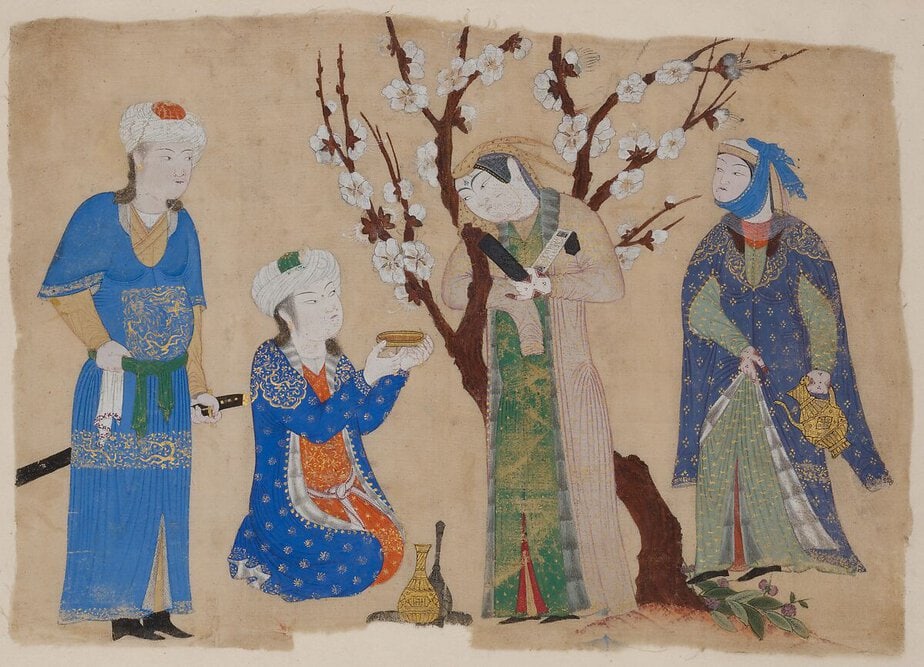
Wine Drinking in a Spring Garden is an excellent example of Timurid miniature painting and reflects the elegance and refinement of courtly life during the Timurid Period.
The artwork portrays a group of noble figures gathered in a beautiful garden surrounded by blooming flowers, lush trees, and carefully designed landscapes.
The figures are shown enjoying wine, conversation, and companionship in a peaceful and harmonious setting.
The painting demonstrates the remarkable skill of Timurid artists through its vibrant colors, delicate brushwork, and intricate details.
The figures wear luxurious clothing decorated with elaborate patterns, emphasizing the wealth and sophistication of the Timurid court.
Every element of the composition, from the floral designs to serene luxury reflects a high level of artistic craftsmanship.
The garden symbolizes beauty, prosperity, and paradise, themes that were highly valued in Persian and Timurid culture.
Beyond depicting a social gathering, the artwork provides insight into the cultural ideals and lifestyle of the Timurid elite.
It illustrates the importance of leisure, nature, and artistic appreciation in Timurid society.