

A commercial lease is more than an agreement about rent and the use of a property. It determines who pays for maintenance, how operating expenses are shared, when rent increases, and what happens when a tenant renews or leaves.
For property owners, managers, and tenants, overlooking even one lease clause can lead to unexpected costs, billing disputes, or missed deadlines.
Consider a retail tenant who receives an annual Common Area Maintenance (CAM) reconciliation that is significantly higher than expected. Before questioning the amount, both the tenant and property manager need to understand what the lease says about recoverable expenses, allocation methods, caps, and audit rights.
This is why understanding commercial lease terms matters long after an agreement is signed.
In this guide, we explain the key lease provisions, their financial implications, and how lease audits and lease abstraction help businesses manage their obligations more accurately.
What Are Commercial Lease Terms?
Commercial lease terms are the conditions that define the rights and responsibilities of a landlord and tenant under a commercial property agreement.
They cover everything from rental payments and lease duration to operating expenses, maintenance responsibilities, renewal options, and termination rights.
Unlike residential leases, commercial lease agreements often include complex financial arrangements that vary by property type, negotiation, and intended use.
For example, a tenant leasing an office in a multi-tenant building may be required to contribute toward shared operating expenses. A retail tenant may have additional obligations involving percentage rent, signage, or permitted business activities.
Understanding these conditions helps both parties avoid disagreements and manage the property more effectively.
12 Important Commercial Lease Terms You Should Know
1. Lease Term and Commencement Date
The lease term establishes how long the tenant has the right to occupy the property.
However, the date a lease is signed is not necessarily the date rent payments begin.
Commercial leases may specify several important dates:
- Execution date: When the agreement is signed.
- Commencement date: When the lease term officially begins.
- Rent commencement date: When the tenant is required to start paying rent.
- Expiration date: When the lease term ends, unless extended.
These dates can differ, especially when a landlord provides a rent-free period or allows time for tenant improvements.
Why it matters: Property managers need accurate lease dates to schedule billing, recognize rent changes, and monitor upcoming expirations.
2. Rentable Square Footage and Usable Space
The amount of space stated in a commercial lease can directly affect rental costs and operating expense allocations.
Two common measurements are:
- Usable square footage: The space available for the tenant’s exclusive use.
- Rentable square footage: The usable area plus an allocated share of certain common areas.
For example, a tenant may occupy 4,500 square feet of usable office space but pay rent based on 5,000 rentable square feet.
The difference may reflect an allocation of common areas such as corridors and shared facilities.
Before signing a lease, tenants should review the measurement standard, agreed square footage, and any provisions allowing future adjustments.
Why it matters: Incorrect measurements or allocation assumptions can affect rental calculations and the tenant’s share of property operating expenses.
3. Type of Commercial Lease
Commercial leases allocate costs differently depending on the agreement.
The most common structures include:
| Lease type | How expenses are generally handled |
| Gross lease | Tenant pays rent that generally includes specified property expenses |
| Modified gross lease | Landlord and tenant divide expenses according to negotiated terms |
| Net lease | Tenant pays base rent plus designated operating expenses |
| Triple net (NNN) lease | Tenant typically pays base rent plus allocated taxes, insurance, and maintenance costs |
| Percentage lease | Tenant pays agreed rent and an additional amount based on sales, commonly in retail |
The lease label alone does not determine every obligation. The actual contract language controls which expenses each party must pay.
Why it matters: Property managers must understand the lease structure before establishing billing schedules or preparing operating expense recoveries.
4. Base Rent and Rent Escalation Clauses
Base rent is the amount charged for occupying a commercial property, excluding separately billed expenses.
Commercial leases often include rent escalation provisions allowing rent to increase during the lease term.
Common methods include:
- Fixed annual increases
- Scheduled increases at specified intervals
- Consumer Price Index (CPI)-linked adjustments
- Increases tied to negotiated renewal terms
Example:
A tenant pays $10,000 per month with a 3% annual rent escalation.
| Lease year | Monthly base rent |
| Year 1 | $10,000 |
| Year 2 | $10,300 |
| Year 3 | $10,609 |
Illustrative figures assuming annual compounding and no other rent adjustments.
Even a simple escalation clause can create billing errors when an effective date, calculation method, or amendment is overlooked.
Why it matters: Accurate rent schedules help property managers apply increases on time and reduce discrepancies between lease agreements and accounting records.
5. Common Area Maintenance (CAM) Charges
CAM charges cover eligible expenses associated with operating and maintaining shared areas of a commercial property.
Depending on the lease, these expenses may include:
- Landscaping and grounds maintenance
- Parking lot maintenance
- Common area cleaning
- Security services
- Shared lighting and utilities
- Repairs and maintenance of common facilities
The amount a tenant pays generally depends on the lease’s allocation provisions and the applicable expense categories.
For example, a tenant occupying 10% of the relevant rentable area might be allocated 10% of eligible CAM expenses, subject to the lease’s specific calculation rules.
If eligible CAM expenses total $200,000, an illustrative 10% allocation would be $20,000 before applying any caps, exclusions, credits, or other contractual adjustments.
Why it matters: CAM provisions are a frequent source of billing questions. Property managers must identify recoverable costs, apply the correct allocation methods, and reconcile estimated charges against actual eligible expenses.
6. Operating Expense Inclusions, Exclusions, and Caps
Not every property expense can automatically be passed on to tenants.
Commercial leases often distinguish between recoverable and nonrecoverable expenses.
Certain agreements may exclude or restrict:
- Leasing commissions
- Selected capital improvements
- Costs associated with another tenant
- Certain legal expenses
- Financing costs
- Expenses reimbursed through insurance
Some leases also contain expense caps or base-year provisions.
An expense cap may limit increases in designated operating expenses, while a base-year arrangement may require tenants to pay a specified share of expenses above an agreed baseline.
These provisions can contain exceptions, particularly for taxes, insurance, utilities, or other uncontrollable expenses.
Why it matters: Applying an expense cap or exclusion incorrectly can result in billing disputes and inaccurate recoveries.
7. Maintenance and Repair Responsibilities
Maintenance responsibilities should be clearly divided between the landlord and tenant.
The lease may specify who is responsible for:
- HVAC maintenance and replacement
- Plumbing and electrical repairs
- Structural repairs
- Interior maintenance
- Common area upkeep
- Emergency repairs
For instance, a tenant may be responsible for routine maintenance of its dedicated HVAC equipment, while the landlord remains responsible for certain structural components.
Why it matters: Clear responsibilities help property managers coordinate vendors, approve work orders, allocate costs, and respond to maintenance issues without unnecessary delays.
8. Tenant Improvements and Alterations
Commercial tenants frequently modify leased premises to accommodate their operations.
These changes may include office partitions, interior fixtures, equipment installations, or retail improvements.
A lease should clarify:
- Whether the landlord must approve proposed improvements
- Who pays for the work
- Whether a tenant improvement allowance is available
- Who owns the improvements
- Whether the tenant must restore the premises when leaving
Why it matters: Tracking improvement allowances, approvals, and restoration requirements helps property owners and tenants manage costs and avoid disagreements at the end of the lease.
9. Renewal Options and Notice Requirements
A renewal option may allow a tenant to extend the lease, provided the tenant satisfies specified conditions.
Important provisions include:
- Renewal eligibility
- Length of the extension
- Rent calculation during the renewal period
- Deadline for exercising the option
- Required method of notification
For example, a lease expiring on December 31 may require the tenant to provide written renewal notice several months earlier.
Missing that deadline could mean losing a contractual renewal right.
Why it matters: Property managers should maintain a reliable calendar of renewal deadlines rather than depending on manual reminders or reviewing leases only when expiration approaches.
10. Lease Termination and Early Exit Provisions
Commercial leases may contain specific provisions governing early termination, default, and expiration.
Depending on the agreement, these may address:
- Early termination fees
- Required notice periods
- Conditions for exercising a termination option
- Default and cure periods
- Restoration obligations
- Security deposit treatment
Not every lease permits early termination, and the financial consequences can differ substantially.
Why it matters: Understanding these provisions helps owners assess potential income changes and helps tenants evaluate the financial implications of leaving a property.
11. Assignment and Subletting Rights
Assignment and subletting provisions determine whether a tenant can transfer its lease interest or allow another party to occupy the premises.
The agreement may require landlord consent, specify approval conditions, or restrict particular uses.
An assignment generally transfers the tenant’s lease interest, while a sublease allows another party to occupy all or part of the premises under a separate arrangement.
The original tenant’s continuing liability depends on the agreement and applicable law.
Why it matters: Property managers need to track approved occupancy arrangements, contractual responsibilities, and changes affecting the property.
12. Lease Audit Rights and Record Access
Commercial leases may grant tenants the right to examine records supporting operating expense charges or other amounts billed by the landlord.
These provisions can specify:
- Which expenses can be reviewed
- How long the tenant has to request an audit
- What records must be made available
- Where and how the review takes place
- Who pays for the audit
- How billing discrepancies are resolved
For example, a tenant reviewing an annual CAM statement may question whether an expense was allocated correctly or whether a prohibited cost was included.
A lease audit compares relevant charges with contractual provisions and available supporting documentation.
Why it matters: Well-defined audit rights and organized records support more transparent billing and help resolve financial discrepancies.
Why Lease Audit and Lease Abstraction Matter in Commercial Property Management
Understanding lease terms is only the beginning. The next challenge is ensuring those terms are applied consistently across billing, reporting, and day-to-day property operations.
What Is Lease Abstraction?
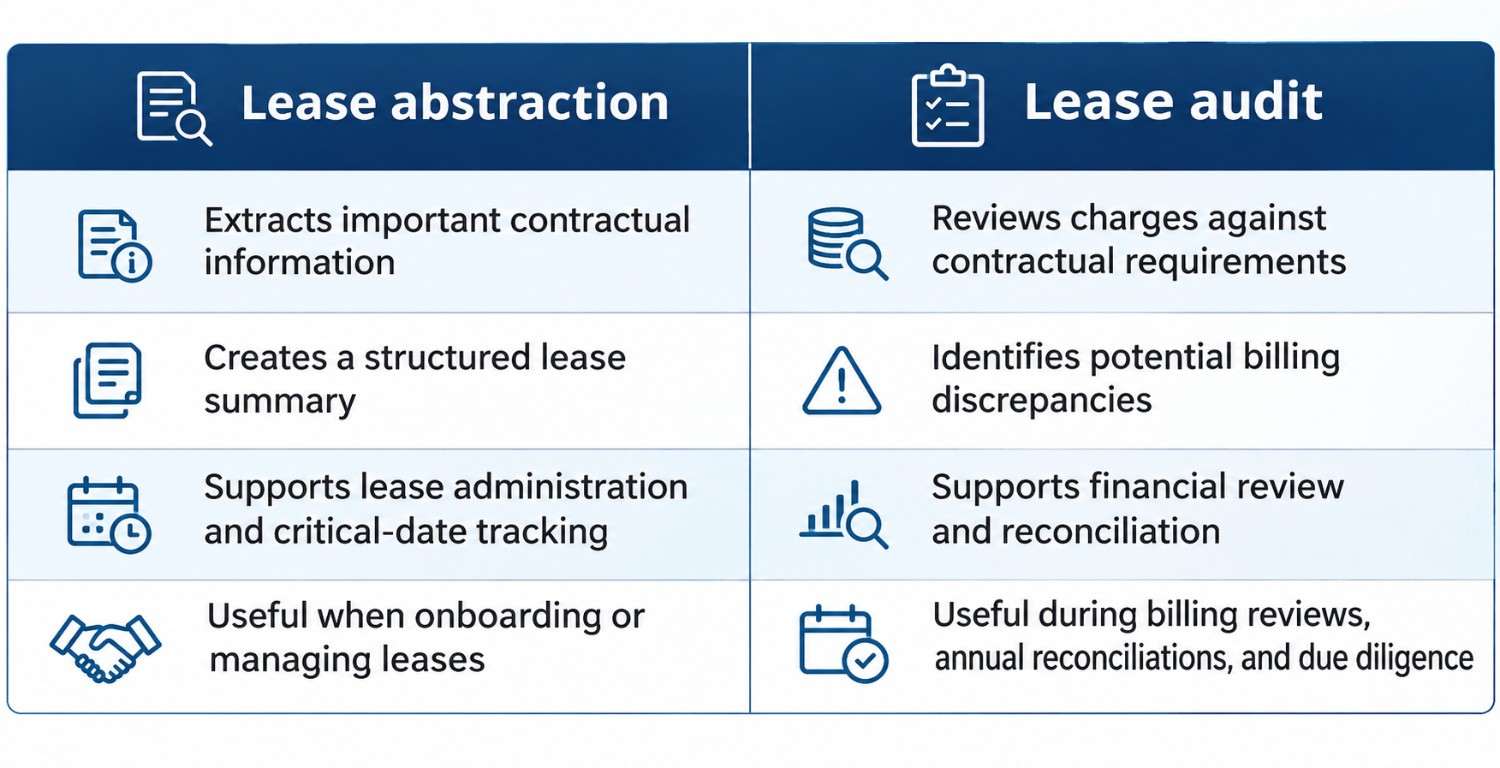
Lease abstraction is the process of reviewing a lease and its related amendments, then extracting essential information into a structured summary.
A commercial lease abstract typically includes:
- Landlord and tenant information
- Property details and leased area
- Lease commencement and expiration dates
- Base rent and escalation schedules
- CAM, tax, and insurance obligations
- Renewal and termination options
- Maintenance responsibilities
- Audit rights and notice periods
Rather than searching through a lengthy lease whenever a question arises, property managers can refer to the abstract to find relevant information quickly.
A well-prepared abstract should also identify the original document sections supporting the extracted information.
Read more: Commercial Lease Abstraction
What Is a Commercial Lease Audit?
A commercial lease audit involves reviewing charges, calculations, and supporting documentation against the provisions of a lease agreement.
Depending on the scope, the review may cover:
- Base rent and scheduled increases
- CAM and operating expense charges
- Property tax and insurance recoveries
- Utility charges
- Rent abatements and credits
- Applicable expense caps
- Other contractual charges
For example, if a tenant receives a CAM reconciliation that appears inconsistent with the lease’s expense exclusions, an audit can help determine whether the billed amounts follow the agreement.
Lease Abstraction vs. Lease Audit
How Commercial Lease Terms Affect Property Management Back-Office Operations
A property manager may oversee leasing, maintenance, and tenant relationships, but many lease-related responsibilities depend on accurate administrative and accounting support.
A reliable property management back office helps translate contractual provisions into everyday processes.
Consider what happens after a new commercial tenant signs a lease.
The team must enter the correct rent schedule, record the commencement date, establish applicable charges, track allowances, and monitor future changes.
If any of these details are entered incorrectly, errors may continue across several billing periods before they are discovered.
Key activities include:
- Lease data entry: Recording contractual information in property management systems.
- Rent schedule maintenance: Updating base rent, escalations, and amendments.
- Tenant billing support: Applying contractual charges and adjustments.
- CAM reconciliation support: Comparing estimated recoveries with eligible actual expenses.
- Critical-date tracking: Monitoring renewals, expirations, and notice requirements.
- Document management: Maintaining organized lease agreements, amendments, and supporting records.
For property management firms overseeing multiple locations, consistent back-office processes help reduce manual work and improve visibility into lease obligations.
Commercial Leases vs. HOA Financial Responsibilities
Commercial lease administration and homeowners association accounting are different functions, although property management organizations may provide both.
Commercial lease administration focuses on rental agreements, tenant billing, expense recoveries, and contractual obligations.
By comparison, HOA accounting services focus on association financial activities such as homeowner assessments, operating budgets, reserve fund reporting, vendor payments, and financial statements.
For firms serving both commercial properties and residential communities, maintaining separate but coordinated workflows helps ensure that lease-related transactions and association financial records are handled appropriately.
Final Thoughts
Commercial lease terms affect more than the amount of rent paid each month. They influence operating costs, maintenance responsibilities, financial reporting, tenant relationships, and long-term property performance.
For tenants, understanding these terms helps clarify financial obligations and contractual rights.
For property owners and managers, accurate lease information supports consistent billing, reliable expense recovery, and better operational decisions.
As portfolios grow, having a structured approach to lease abstraction, administration, and audit becomes increasingly important.
The goal is not simply to understand what a lease says. It is to make sure the property is managed according to those terms.
How OHI Supports Commercial Lease Administration
Managing commercial lease data across multiple properties can demand significant administrative and accounting resources.
Outsourcing Hub India (OHI) supports real estate owners, investment firms, and property management companies with lease abstraction, lease administration, lease audits, CAM reconciliation, and related back-office services.
Our teams assist with extracting critical lease provisions, maintaining rent schedules, reviewing contractual charges, tracking important dates, and organizing lease information within property management systems.
Whether you are onboarding a newly acquired portfolio or reviewing existing lease records, OHI can help your team maintain more consistent lease data and improve financial oversight.
Looking to improve lease data accuracy or review commercial lease charges?
Explore OHI’s Lease Audit and Lease Abstraction Services to learn how our team can support your commercial real estate operations.