

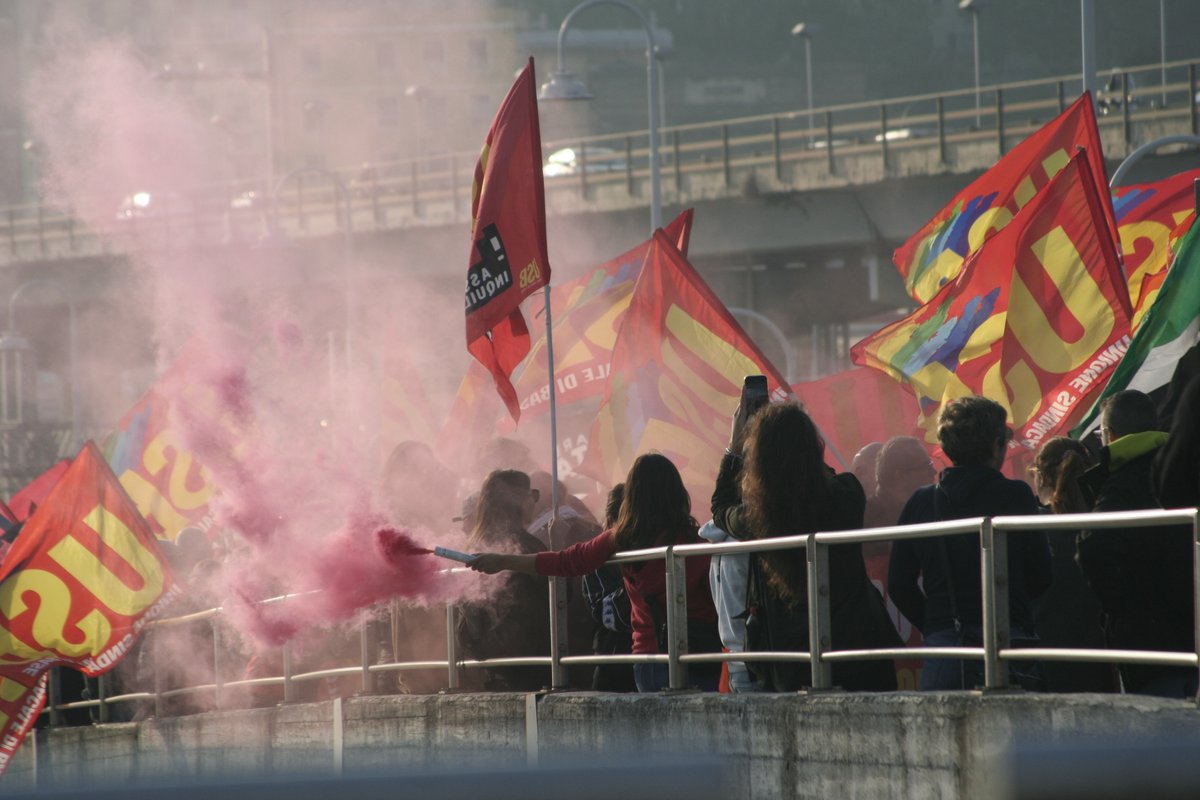

There is a popular saying in Genoa, a northern Italian city whose harbor faces the Ligurian Sea. It was first uttered in the seventeenth century by dockworkers, known as the camalli: “Dateci una palanca in meno ma lasciateci mugugnare,” which more or less translates to “Pay us less, but let us protest.”
The city is known for its rich history of social unrest and resistance. In 2001, it hosted the twenty-seventh G8 summit, at which police violently repressed antiglobalization protestors. Italy awarded the same city with a gold medal for its resistance to Nazi fascism, where anarchist, communist, and other partisan groups liberated Genoa by themselves, before the Allies ever arrived.
Genoa is now one of many urban centers protesting the government of Italian Prime Minister Giorgia Meloni and its far-right party Fratelli d’Italia (“Brothers of Italy”), which governs alongside the center-right Forza Italia party and the far-right Lega party.
Like other European countries, Italy is suffering a severe cost-of-living crisis fueled by U.S. President Donald Trump’s war against Iran and its proxies, including the Houthi rebels in Yemen. In this latest escalation, Italy has found itself involved as a historical ally of the United States and a member of NATO. The closure of two key maritime chokepoints—the Strait of Hormuz and the Bab el-Mandeb Strait—have strained Italy’s importers and exporters and hiked prices for oil, gas, fertilizer, and staple crops, becoming the last straw for many people throughout Italy.
In October, youth protesters in Milan organized on social media platforms to carry out an anti-government demonstration, which drew thousands of young attendees—many of whom were violently suppressed with water cannons and tear gas. In the days following the initial demonstrations, protests gained traction across the country as Meloni’s government deployed military troops, initiated security measures, and declared a state of emergency to deter demonstrators.
After the first protests, Meloni accused second-generation, naturalized Italians—mostly children of North African immigrants—of causing damage. In October, Meloni supported the Lega party’s decree law titled with a racist term for Moroccan and, more broadly, North African immigrants to target these populations. The bill amended Article 98 of the criminal code to assume capacity for crime for minors aged fourteen to eighteen. Prior legislation evaluated youth in this age range on a case-by-case basis to decide if the person involved had the capacity to understand their actions. Meloni then pushed for the detention of the so-called instigator of the youth looting, Youssef Siher, who created an Instagram page only after the riot took place and was released a few days later.
Following the lead of youth activists, Italian trade union Unione Sindacale di Base (USB), or the Autonomous Trade Union, called for a general strike on October 30 to protest military government spending and the cost of living—under the slogan “Lay down your weapons, raise your wages.” But just days before the strike, transport minister Matteo Salvini announced a precettazione, the legal but contested injunction governments use to restrict strikes among essential public service workers. A precettazione is officially deployed to balance the right to strike with health, safety, and freedom of movement, but in practice is often used to suppress activist movements. The October order by Salvini included only the transport sector, but the USB stated its workers would walk out anyway, calling the order “illegitimate.”
In Genoa alone, at least 10,000 people took to the streets, while thousands of others stayed home from work. Dockworkers were joined by students, teachers, and steelworkers.
“It’s been fifteen years that we have been trying to deliver the message, as a collective of workers, a simple message: stop wars,” José Nivoi, spokesperson of the Autonomous Collective of Port Workers, tells The Progressive. “We see weapons transferred from the harbor to Israel, Saudi Arabia, and Libya. And now the current situation is confirming what we were defending. Social unrest has spread to American, Latin American, and Indian harbors, with the same thesis: rearmament is causing poverty, and national repression worldwide is pointing to the same issue.”
Last year, Genoa dockworkers made headlines after shutting down the city’s port in support of Italian delegates—including Nivoy and two others from Genoa—on the Global Sumud Flotilla who were detained by Israeli forces. “If they don’t let our guys free, not a single screw will leave this port,” protesters chanted.
Many Palestinian flags fluttered amid the smoke of burnt tires near the starting point of the rally on October 30.
“We believe in people’s self-determination, from Gaza to all of the Middle East, including Lebanon,” Nivoi says. “Shipowners and CEOs are getting profits from global exploitation.”
The procession marched along the street that leads from the harbor to the ancient city center, and then, at a roundabout, screams of joy and applause: A second section of protesters, led by high school students, welcomed the dockworkers with chants and waving hands. Soon after, a wave of researchers, academic professors, school teachers, and janitors joined with signs, chanting “Siamo tutti antifascisti” (“We are all anti-fascists”).
Genoa experienced a particularly tense October after Acciaierie d’Italia, the largest steel company in Italy, announced the closure of its production plant in Taranto in southern Italy, causing the possible closure of its plant in Genoa, prompting several days of strikes and protests. Shutting down the site would have affected 900 families in Genoa alone. Acciaierie d’Italia, once known as Ilva, has employed thousands of workers in the city, but has also polluted the neighboring area of Cornigliano to the extent that incidences of cancer caused by iron and other raw material particles skyrocketed.
The steel industry was historically a crucial manufacturing sector for Italy and Genoa in particular, but the past decade has seen a decrease in output. The fight for the steelworkers’ rights involved the whole city, from several local officials picketing in solidarity to common people applauding their struggle. In October, protesters displayed a banner in the central roundabout that read: “Dad, your fight, my future.”
A week before the general strike of October 30 and after workers had occupied the local airport in protest, the Italian government and Acciaierie d’Italia executives signed an agreement to keep part of the plant operating. Workers are not convinced the government will follow through on the promise.
During the general strike, many Acciaierie d’Italia workers joined the procession flooding the streets of Genoa.
“We are here to keep attention right on our cause,” Matteo Bellapianta, a second-generation Acciaierie worker, tells The Progressive.
The protests lasted all day. One group of teachers sat in the sun, waiting for the lunch break to finish so the procession could continue. Students and educators from primary school through university attended, holding banners and rage. Italy’s expenditure for research and schools is below the European average of 4.8 percent, at just 4.1 percent of the country’s GDP. Students and professors lament that while the government’s military expenditures are on the rise—allocating more than 1.3 billion euros for 2027 to 2028 foreign military missions—ceilings are falling down on students in schools, the cost of books is rising, teachers are receiving the lowest wages in Western Europe, and there’s a shortage of educators.
On the same day as the general strike on October 30, Meloni’s administration proposed cutting funding—though eventually backtracked—for school personnel while working on its budget law, cutting nearly 7,000 education jobs.
“Striking is still a right guaranteed by the Constitution,” Giulia Bergamaschi, an elementary school teacher, tells The Progressive. “I am here as a citizen and a teacher because unacceptable things are happening, and decisions which concern all civil society are being made that I deem are at a sidereal distance from any agreeable concept of ‘education.’ ”
Among her complaints is what she calls the “militarization of education.” In Italy, militaristic content has been introduced to the classroom with increasing frequency, backed by agreements between the Ministry of Education and the Ministry of Defense. In strikes throughout the year, peace organizations and teacher syndicates have organized against the “rhetoric of war.”
“Policemen enter schools, sometimes to campaign for enrolled young students or, worse, to threaten the students occupying colleges with acts of intimidation like random police records,” Bergamaschi says.
Ginevra Triuzzi, an elementary school teacher at the protest, says she is frustrated by her school administration, which hired substitute teachers to fill in for educators absent during the strike.
“Even though my colleague and I were out protesting, they made the children enter the school with another colleague,” Triuzzi says. “That’s unfair, because they maintained the service available and the scope of a strike is to stop it. This weakens our protests.”
Triuzzi has been working in public education for six years. In that time, she has witnessed the decline of the quality of public schools: “Funds are cut, formation materials for teachers and students are waning. It is unacceptable.”
In September, Italy’s Ministry of Education and Merit proposed a bill limiting the number of “foreign students” in classes to reduce the number of second-generation migrants in Italian schools. Many groups labeled the measure as “fascist,” stating it echoes the 1938 Mussolini Racial Bill—which stripped Jewish citizens of their civil rights, including banning them from schools and barring them from working in the government, military, and banking. Marriage between Italian “Aryans” and Jewish, African, or non-Aryan citizens was also prohibited. The Education Ministry’s proposal had to be adjusted multiple times to be considered constitutional.
Protesting the legislation, students at the G. Daneo Primary School in Genoa made and displayed a banner outside the school that read: “In Daneo’s classroom, no one is a foreigner.” The sign was torn down by two undercover agents with the Italian State Police’s specialized counterterrorism division, sparking protests.
Lucio Maccarone, founder of the Collettivo InSegno—a teacher association founded to protect teachers—explains why teachers should participate in protests: “We share both the reasons of students and workers’ claims. And also, if anyone has a child going to school, they should be concerned about the quality of the education, from infrastructures to the freedom of teaching, which should be protected by the Constitution.”
He adds, “And then, there’s the cost of living. There are some colleagues who are forced to share an apartment with other teachers in their forties because they cannot afford a private place for themselves. The cost of living has risen but our wages are stuck.”
Another banner at the rally stands out: “We STEM students won’t be the theoreticians of your wars.” The University of Genoa has been developing a project to relocate its engineering departments to a new technological campus in Erzelli, in the western part of the city. The project, which dates back to 2006, has gained momentum in recent years when, in 2022, the regional administration provided funding. Just a few miles away is an industrial facility run by Leonardo, one of the wealthiest weapons manufacturers in Italy.
The connection is not merely geographical: The University of Genoa has also signed a formal cooperation agreement with Leonardo, covering research, technological development, industrial PhDs, and student training.
Student activists argue that the new campus risks further intertwining higher education and research with the interests of the defense industry, and question the priorities behind the project, which is slated to open in 2029.
“The Erzelli campus, which is supposed to host the students of the STEM faculties, sits right next to one of the biggest military industry hubs as well as one of the biggest investors in the university,” Valentina, a young activist with a student collective that occupied several facilities in recent weeks, tells The Progressive. “This project was costly while students’ loans are more and more expensive and infrastructures are falling apart. That says a lot about the directions that the administrations have planned for this project.”
Genoa—today is also a lively touristic city thanks to its medieval heritage and warm weather—is among the first Italian tourism hubs to introduce a tax on cruise tourists in order to contain the side effects of overtourism on citizens, like soaring rent prices.
On the day of the general strike, tourists watched the long procession, which kept them from leaving their ships. Some of them took pictures while others showed protesters the middle-finger, seemingly angry that their time in the city was interrupted. The procession didn’t flinch, but rather buzzed with enthusiasm.
On November 20, protesters will take to the streets once more in a nationwide general strike to address the cost of living crisis.
In Genoa, recent protests show that the city’s antifascist and pro-labor history lives on in the unbending principles of its dockworkers and students.


