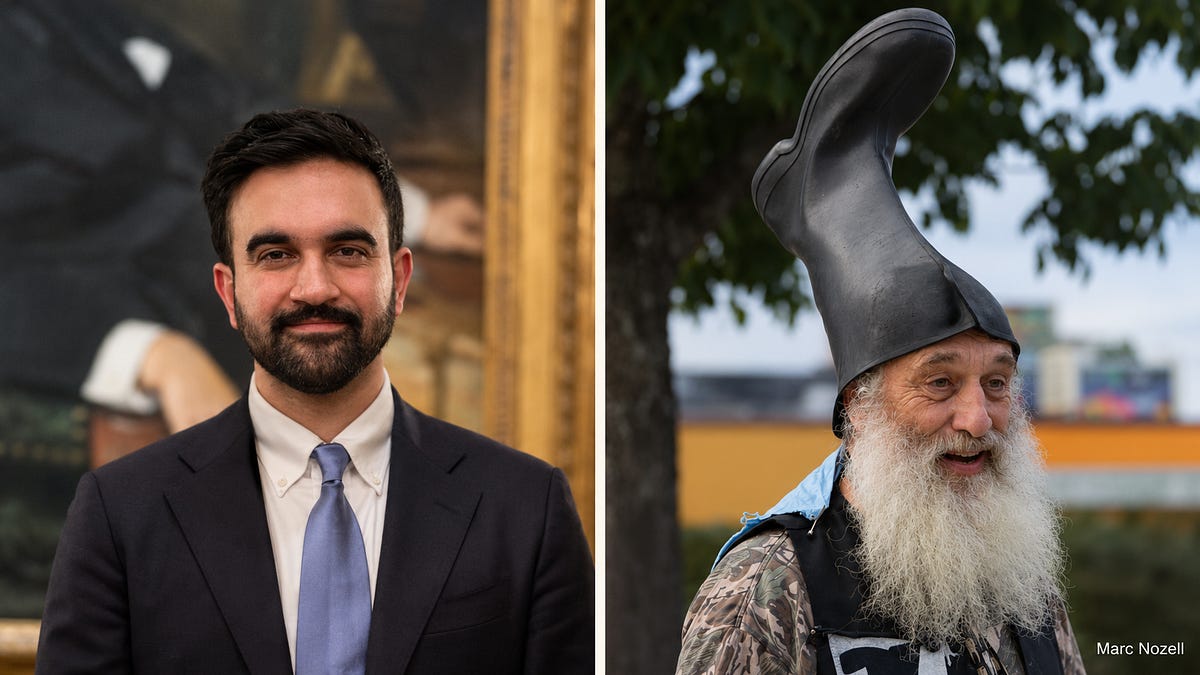
The other day I asked a question on Facebook. The Democratic Socialists of America (DSA) have gone, over the course of about a decade, from an organization that almost nobody had heard of to one with a mayor in New York City and, after this month’s midterms, a small but growing bloc in Congress. Libertarians, by contrast, have been at it for more than fifty years and have nothing comparable to show for it.
To me, this seems like a learning opportunity. Clearly the DSA is doing something right. So what can libertarians learn from them?
My own hunch was that a lot of it has to do with electoral strategy. Libertarians have channeled much of their energy into the Libertarian Party (LP). But in an electoral system like we have in the United States, almost nobody wants to vote for a third-party candidate because they perceive (correctly) that third-party candidates have very little chance of actually winning. Candidates who are serious about winning need to run in one of the two major parties. And so the LP has tended to attract, by and large, candidates who are not serious.
The DSA, in contrast, is an organization that defines an ideology and a political agenda, but that does not run candidates for office. It’s not really a political party at all. It’s a membership organization that endorses candidates, most of whom run through the Democratic Party, where they actually stand a chance of winning.
My post drew a lot of responses, many of which were quite good. Some people argued that socialists fit comfortably on the left edge of the Democratic Party in a way that libertarians, who agree with each party about half the time, don’t fit in either one. Others pointed out that libertarians already tried something like the DSA approach with Ron Paul. A few denied the premise and said libertarians have had plenty of influence on the Republican Party.
But the most popular response from libertarians struck a more defensive chord. “DSA promises free stuff,” one commenter wrote. “LP promotes personal responsibility. There’s your answer.” Another: “They offer benefits paid by others. That’s the key to their success.” The comment that drew the most reactions in the whole thread said that socialism “offers people free stuff,” while libertarianism “only offers freedom.”
I can see the appeal of this. One commenter defended a careful version of it, on which nobody has to be stupid or wicked; there’s just no reason to assume that every political philosophy strikes people as equally attractive on first contact. Still, I told the thread that the answer seemed suspiciously convenient to me. It puts the whole responsibility on the voters and none of it on libertarians themselves, which is an odd move for people who talk as much as we do about personal responsibility. But, nevertheless, my suspicion isn’t evidence any more than their intuition is. The free stuff theory is an empirical claim about why people vote the way they do, and it makes predictions we can check.
* * *
The first thing to say is that the theory has already been tested, many times, and that the results have been popularized by a scholar whom many of my libertarian commenters know well. In 2001, the libertarian economist Bryan Caplan published an article titled “Libertarianism Against Economism.” His subject was what political scientists call the self-interested voter hypothesis, the idea that people vote for whatever benefits them personally. Caplan’s summary of several decades of research is that the hypothesis does badly. Measures of self-interest, he wrote, “have little or no predictive utility for beliefs about unemployment policy, national health insurance, busing, or crime.” The elderly “seem if anything to be less in favor of Social Security and Medicare than the rest of the population.” There are exceptions, which Caplan is careful to note: homeowners who expected big savings were more likely to support California’s tax revolt, and smokers really don’t like cigarette taxes. For the most part, though, what predicts a person’s vote is what that person thinks is good for the country, not what they think will line their pockets.
We can check these findings against what we’re seeing in politics today. If the self-interested voter hypothesis were correct, then the DSA’s strongest support should come from the people with the most to gain from free stuff. Zohran Mamdani ran for mayor of New York on free buses, a rent freeze, and city-run grocery stores. But according to the Associated Press, which broke down the results of the 2025 Democratic primary by neighborhood income, “Cuomo won more votes than Mamdani among the lowest-income voters.” Mamdani’s coalition, in contrast, “was largely made up of middle-income voters,” and of the fifteen neighborhoods with median household incomes over $150,000, he won eight. Neighborhood data can’t tell us how any individual voted, and a primary electorate isn’t the whole city. Still, the theory predicts that support should rise as income falls, and that simply isn’t the pattern we saw.
Another way to test the hypothesis is to look at what happens when free stuff goes on the ballot directly, with no candidate attached. In 2016, Colorado voters were offered universal health coverage. They turned it down by about 79 to 21. That same year the Swiss were offered an unconditional basic income, and 77 percent said no. Of course, “free” stuff isn’t really free, and I suspect that most voters know this at some level and that it makes a difference in their decisions. Colorado’s plan came with a new 10 percent tax on income, and the opposition’s ads told voters it would raise their taxes by $25 billion a year. And we can see how costs affect voters’ preferences in polling data as well. In a KFF poll this September, 66 percent of Americans favored Medicare for All; but 64 percent opposed it after hearing that it could mean higher taxes. This isn’t what you’d expect to see if voters could be easily bought off by the promise of taxpayer-funded goodies.
But there’s a bigger problem with the free stuff theory, one that’s not empirical, but logical. The problem is that you can’t explain a change with a constant. Libertarians know this, and have made the same argument, correctly, in other contexts. “Greed” can’t explain price increases in inflationary times because people are always greedy. Similarly, free stuff can’t explain why socialists are winning now because socialists have always been offering free stuff. But the DSA’s success is relatively new. The DSA had about 6,000 members in 2015. According to figures the organization gave City & State, it had about 76,000 in the summer of 2021 and more than 120,000 this year. Whatever explains that increase (Bernie Sanders, Donald Trump, a candidate with Mamdani’s talent), it can’t be the one thing that never varied.
* * *
A careful reader will notice that this last argument cuts against my own hunch too. The DSA has been working inside the Democratic Party since it was founded in 1982, and for most of that time it got nowhere. So electoral strategy can’t explain why socialists started winning when they did, any more than free stuff can. I think that’s right. My claim is only that running in a major party’s primaries is a necessary condition of electoral success, and nobody should mistake it for a sufficient one. Something else had to change before the strategy could pay off. But when it did, the DSA was in a position to take advantage. The Green Party, which offers voters much the same free stuff on a third-party line, was not, which is a big part of the reason why no Green has ever been elected to Congress. This month’s six new socialist members all won in what NPR called “reliably blue” districts, the kind of place where the election that matters is the Democratic primary.
What puzzles me is that so many libertarians seem to find the free stuff theory comforting. If it were true, it would be terrible news. Nothing we could say or do would matter, because we’d always be outbid. Caplan saw this twenty-five years ago. He described the belief “that libertarian reform is impossible because it goes against basic human selfishness” as a form of pessimism that rests on a mistake, and he thought libertarians wouldn’t get anywhere until they got past it. About half of Americans tell pollsters they’d prefer a smaller government that provides fewer services. And yet the Libertarian Party’s last presidential candidate got less than half a percent of the vote. Free stuff doesn’t explain the distance between those two numbers, and I don’t think we should want it to. Moving the world in a libertarian direction “is obviously difficult,” Caplan wrote, but “what obstructs it is something other—and presumably weaker—than basic human selfishness.”