


-
Cobble Hill Estate Pinot Noir 2025 | Winemaker Dylan Sheldon | Cowichan Valley, Vancouver Island, BC
-
Unsworth Vineyards Saison Vineyard Pinot Noir 2023 | Winemaker Dan Wright | Cowichan Valley, Vancouver Island, BC
-
Domaine Bernard Defaix Bourgogne Pinot Noir 2024 | Burgundy, France
-
Blue Grouse Cowichan Valley Pinot Noir 2024 | Winemaker Stacy Hornemann | Cowichan Valley, Vancouver Island, BC
-
Giant Steps Circle of Fifths Pinot Noir 2024 | Yarra Valley, Victoria, Australia
-
Loveblock Pinot Noir 2022 | Central Otago, New Zealand
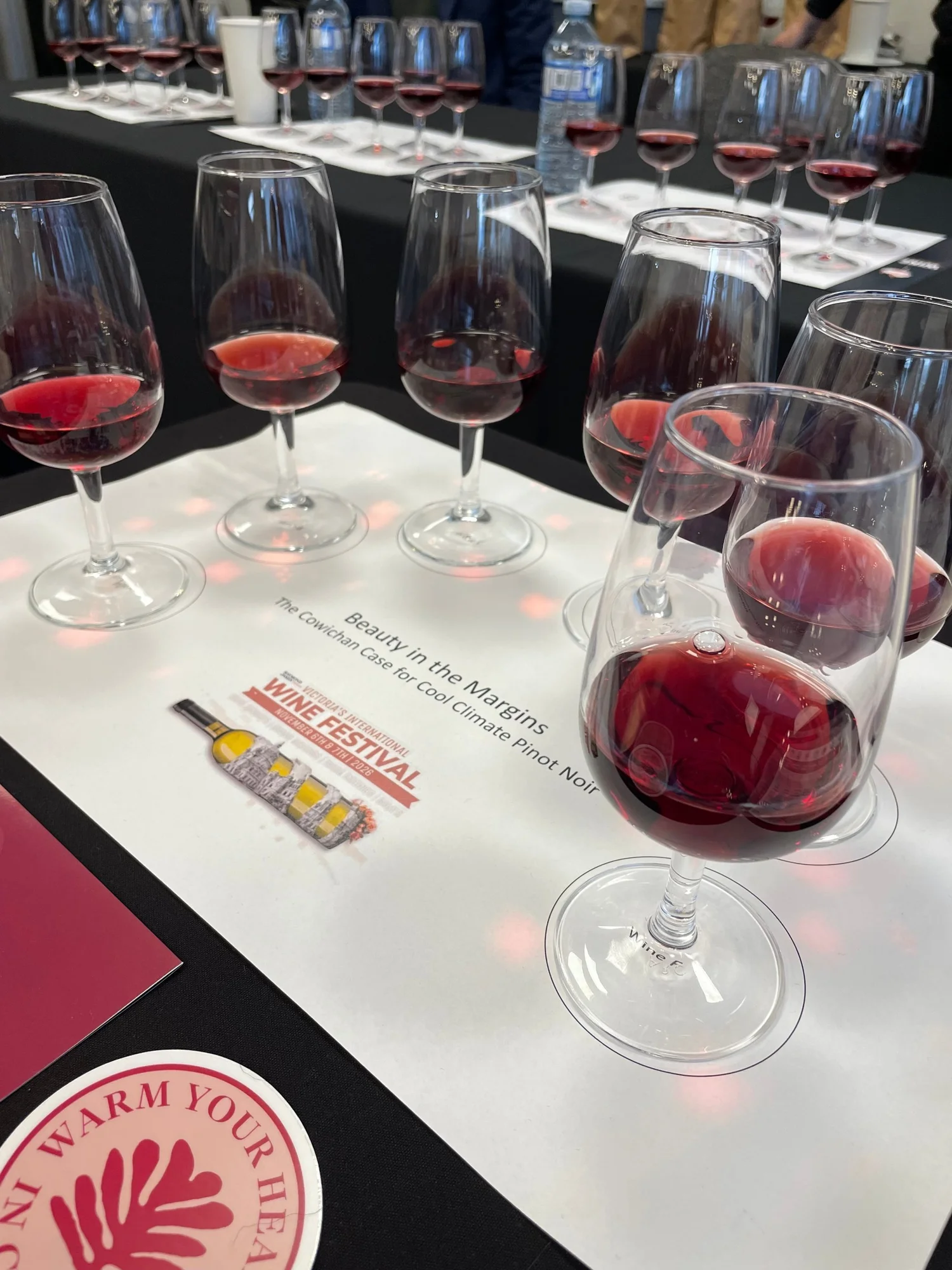
Poured blind in this order, Wine A to Wine F. The three Cowichan wines sat among Burgundy, Australia and New Zealand.
The reveal: three from Cowichan, three from around the world.
The technical slides in the presentation helped explain why these wines felt so composed. The Unsworth Saison Vineyard sits on a slope falling from 65 to 40 metres, planted on glacial till (a mix of cobbles and rock with loam left behind by retreating glaciers). The fruit was destemmed, fermented with wild yeast, aged fifteen months in French oak (only 15% new) and bottled unfined and unfiltered, at 12.9% alcohol.
Blue Grouse blended its own estate fruit, grown on silty loam with marine deposits, with grapes from the same Saison Vineyard. Stacy fermented in stainless steel and terracotta amphorae (clay vessels that let a wine breathe without adding oak flavour), then aged the wine in French and Hungarian oak (only 17% new) and amphorae. The wine came in at just 11.5% alcohol, a number that would be hard to achieve in many warmer regions.
Stacy Hornemann talking through the 2024 Blue Grouse Pinot Noir.
Dan summed up the Island style neatly: ripe fruit that never feels jammy or overripe, freshness and acidity in spades, and lower to moderate alcohol.
Specialize, or keep experimenting?
One of the liveliest moments of the seminar came when the conversation turned to identity. Should Cowichan plant its flag firmly on Pinot Noir, the way Central Otago and Oregon did? Or should it keep experimenting, as Dylan currently does with his 27 varieties?
Gilian gently pushed back, playing the part of the curmudgeon in the room: “The mark of any region that has made its way into the world most successfully is focused.” Her point was that world recognition rarely comes from doing a little of everything. It comes from mastering one or two signature styles that critics and drinkers instantly associate with a place.
Dylan’s answer was rooted in curiosity. In a valley that has only been growing grapes commercially for around thirty years, nobody can say yet which varieties will be truly exceptional here. His 27 varieties are not a reluctance to commit; they are an ongoing field trial. We simply won’t know what Cowichan’s soils, rain shadow and maritime pockets do best until someone plants it and tries.
My instinct is that the answer is both. The region is still too young to stake everything on one grape, and some of its most exciting discoveries (the varieties that turn out to be exceptional here) are probably still to come. That said, with a bit of focus and some confident storytelling, Cowichan Pinot Noir could become a name people recognize far beyond the Island. A flagship does not have to mean the end of curiosity.
“We have ripeness without it feeling jammy, freshness and acidity in spades, and lower to moderate alcohol.” – Dan Wright, Winemaker, Unsworth Vineyards
A vintage guide for Island Pinot
Dan finished with something particularly useful for anyone buying Cowichan Pinot Noir: a quick tour of recent vintages. 2021 was shaped by the heat dome. 2022 began with a cool, wet spring and finished with a warm, dry fall, with picking stretching to the end of October and wines on the delicate side. 2023 was warm and easy. 2024 brought challenging rains and a mid-October harvest. 2025 was warm and early, and 2026 was the earliest yet.
His advice: reach for 2022 and 2024 if you love lighter, more delicate wines, and 2023 and 2025 if you prefer a little more structure. Keep an eye out for 2026 in a couple of years, too.
Back out on the festival floor
After the seminar, I walked out into the public tasting, where wineries from many countries were pouring side by side. It is a rare thing to have so much of the wine world in one room in Victoria. However, what struck me most were the BC tables. They consistently had lines and groups gathered, while some of the international tables were noticeably quieter.
After an afternoon spent asking whether Cowichan could hold its own against Burgundy, Australia and New Zealand, it was lovely to see the answer playing out in real time. People wanted to taste what was growing in their own backyard. Beauty in the margins, it turns out, has quite a following.
Blog post written by: Katelyn Bauer, Vancouver Island Representative, uncorkBC


