Choosing an undersized air compressor for your warehouse causes the unit to struggle with simultaneous tool use, leading to pressure drops that slow pneumatic tools and shorten their service life. An oversized compressor creates cycling inefficiency while driving up energy costs.
Picking the right system means weighing several factors and knowing when a situation calls for professional input.
Assess Your Warehouse’s Compressed Air Needs
Every warehouse places different demands on its compressed air system depending on how it operates day to day. That demand generally falls into one of three patterns:
- Occasional: Short bursts of use followed by long stretches of idle time
- Continuous: Steady demand sustained across multiple shifts
- Variable: Demand that swings significantly between tasks or times of day
Identifying which pattern best describes your operation determines the duty cycle rating your compressor needs to reliably handle demand. Adding up the maximum-rated cubic feet per minute (CFM) of every tool overstates actual demand, since tools rarely run at full capacity simultaneously. In one study, actual air consumption across 434 tools measured only 15% of their combined maximum-rated capacities.
CFM requirements for warehouse air tools should reflect actual day-to-day usage across manufacturing and industrial environments.
What Size Air Compressor Do You Need for a Warehouse?
Warehouse air compressor sizing requires mapping out various variables for every piece of equipment:
- Required airflow: The volume of air required by each tool or process, measured in CFM
- Required pressure: The pressure each tool or process needs to operate, measured in pounds per square inch (PSI)
- Highest-demand equipment: The piece of equipment with the greatest airflow and pressure requirement
- Simultaneous operation: The number of tools you intend to run at once, determining your realistic peak load
- Duty cycle and operating hours: Expected daily runtime, determining whether intermittent- or continuous-duty equipment is appropriate
- Future expansion: Plans for additional equipment or shifts, affecting how much headroom to build in your current system
Add a small contingency margin on top of that total to account for normal fluctuations in demand. Check manufacturer specifications for CFM and PSI for every tool rather than estimating.
Since your compressor must meet the pressure and flow requirements of the most demanding equipment, a single high-demand tool raises energy consumption across the system. Energy consumption increases by 0.6%-1% for every 2 PSI increase above 100 PSIG. A dedicated booster is often more economical than raising pressure plant-wide.
Lastly, account for pressure loss through piping, filters and dryers. Well-designed systems keep the total pressure drop to less than 10% of the system pressure.
Choose the Right Compressor Type
With demand and sizing established, the next decision is which compressor technology fits.
Reciprocating Compressors
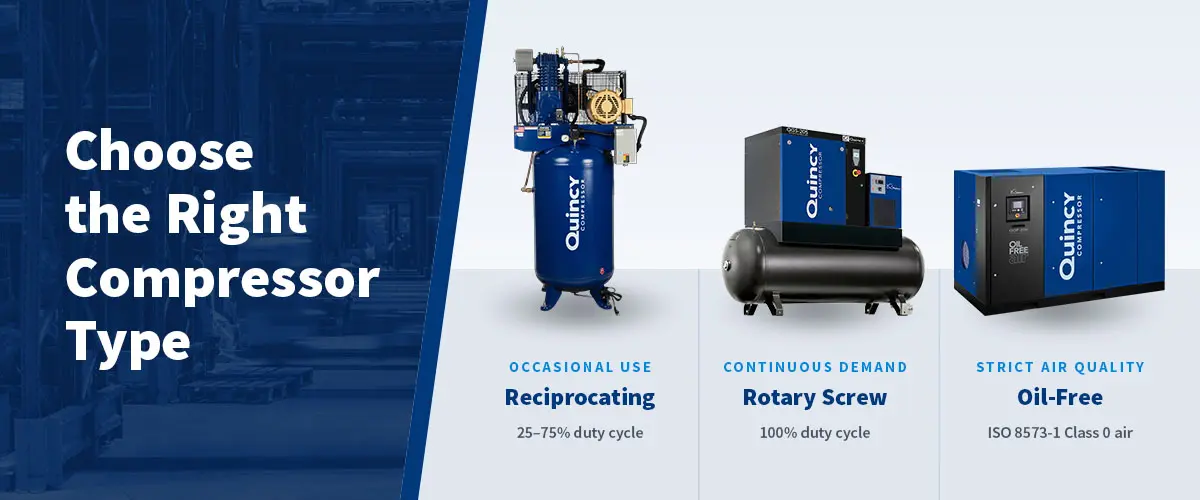
Reciprocating piston air compressors typically carry duty cycle ratings of 25% to 75%, making them practical for facilities with modest air demand and long idle periods between uses. As sustained demand increases, rotary screw compressors tend to become the more practical and efficient option.
Rotary Screw Compressors
Built for continuous duty, rotary screw compressors are the standard choice for multishift warehouse operations with sustained, heavy air demand. These compressors typically carry a 100% duty cycle rating and deliver smooth, consistent airflow rather than the pulsing output typical of reciprocating compressors.
Oil-Free Compressors
Oil-free compressors meet strict air quality requirements where oil contamination would threaten product integrity or compliance. Some oil-free air compressors deliver ISO 8573-1 Class 0 air.
Consider Air Quality Requirements
Compressed air systems manage four main contaminants, including moisture, oil carryover, particulates and microbial contamination. Every application carries different tolerance levels, and selecting the right air treatment solution forms a core part of compressor selection.
The ISO 8573-1 purity classification standard establishes air quality classes based on solid particulates, humidity and oil content. Most applications fall into three categories:
- Plant air: This category covers general-purpose tools and blowoff applications.
- Instrument air: This category covers control systems and sensitive equipment.
- Process air: This category involves direct contact with products and demands the strictest purity.
For facilities with the strictest requirements, oil-free air compressors can eliminate one of the main sources of contamination by removing oil from the compression process.
Evaluate Energy Efficiency and Operating Costs
Besides the up-front cost, consider the long-term operating costs of your equipment. According to some reports, energy accounts for approximately 76% of an air compressor’s total cost of ownership, with operating costs reaching 88% of the lifetime cost when maintenance is included.
Here are some tips you can implement to improve efficiency:
- Use variable-speed drive compressors: These units adjust output to match real-time demand.
- Identify and repair leaks: Poorly maintained systems lose 20% to 30% of output to leaks, while well-maintained systems lose under 10%.
- Turn off your equipment: Switch off your air compressor whenever it is not in use.
- Adjust air pressure: Modify the air pressure to match the application’s requirements.
- Maintenance: Clean filters, proper fluid levels and timely parts replacement improve efficiency and longevity.
Plan the Installation Location
Installation location affects both performance and safety:
- Ventilation: Compressors generate significant heat, so ensure adequate airflow to prevent thermal buildup that shortens equipment life.
- Ambient temperature: Hot environments may reduce compressor capacity and raise overheating risks, while cold environments can cause condensation and starting issues.
- Noise: Compressors generate significant noise, so you may need an acoustic enclosure or a separate room to meet OSHA standards.
- Accessibility: Technicians need clear space on all sides for service visits.
- Electrical capacity: Verify available voltage, phase and amperage before specifying equipment.
- Drainage: Plan for condensate collection and management from the start.
Account for Storage and Distribution
Besides the air compressor, air storage and distribution play an important role in delivering stable air to your warehouse. Air receivers, the storage tanks that hold compressed air downstream, absorb demand spikes, stabilize pressure and reduce compressor cycling. Your warehouse’s air compressor tank size should account for peak-demand bursts as well as the compressor’s instantaneous output.
Undersized piping ranks among the most common causes of pressure problems in otherwise well-specified systems. Size your piping to maintain an air velocity of 20 ft/sec or less to minimize turbulence and pressure drop. Looped distribution systems also maintain more consistent pressure than dead-end runs because they allow air to flow from two directions.
Common Warehouse Air Compressor Selection Mistakes
A few recurring mistakes account for most compressed air problems after installation:
- Undersizing: Pressure drops during peak demand, overworked equipment and a shortened service life
- Oversizing: Cycles between loaded and unloaded operation, wasting energy and generating excess heat
- Ignoring peak demand: Inability to handle simultaneous tool use or sudden surges
- Failing to plan for expansion: Potential needs for costly future updates
When to Consult an Air Compressor Professional
Certain situations call for direct engagement with a compressed air professional before specifying equipment:
- Multishift facilities where downtime is costly and demand is hard to estimate without data logging
- High-demand applications running complex or highly variable load profiles
- Facilities with complex distribution systems involving multiple drop points, long piping runs or buildings
- Planned expansions that require the system to scale significantly
- Situations where a warehouse compressed air system audit adds clarity
An authorized dealer can assess demand and recommend the right system configuration.
Discover Your Ideal Warehouse Air Compressor With Quincy Compressor
The right air compressor matches your warehouse’s actual airflow, pressure, duty cycle, air quality and growth plans. At Quincy Compressor, we provide compressed air solutions for warehouses of all sizes and across numerous industries, from oil and gas to food and beverage. Since 1920, we have delivered legendary performance and reliability, and our authorized dealers bring that experience directly to your facility.
We assess your specific demand profile and recommend the right system configuration, backed by industry-leading warranty protection and 24-hour service support. Connect with a sales and service representative or use the dealer and service locator.