10 Best Prop Firms In 2026: Payouts, Fees & Rules


Key takeaways
- Tracked prop firm payouts are nearing $1.97 billion across 45 firms since October 2023, with more than $115 million recorded in November alone, according to Payout Junction.
- Payout totals show that payments occurred, not that the average trader is profitable after challenge fees, resets and subscriptions.
- A $100,000 futures account with a $3,000 maximum drawdown leaves very little room for error; compare loss allowances and profit targets, not account size.
- Consistency rules, payout buffers, withdrawal caps and trailing drawdowns can stop a profitable trader from withdrawing.
- The guide compares ten firms across forex, futures and crypto based on published rules, not firsthand testing. Payouts are never guaranteed.
Prop firm payouts are approaching the $2 billion mark, with data from Payout Junction showing nearly $1.97 billion in cumulative payments across 45 tracked firms since October 2023. More than $115 million has been recorded in November 2026 alone.
The figures offer a glimpse into how large the funded trading industry has become. But finding the best prop firms in 2026 requires looking at something payout leaderboards rarely tell you: what traders actually have to go through to get paid.
A $100,000 futures account with a $3,000 maximum drawdown gives a trader just $3,000 of room for error. Add consistency requirements, withdrawal caps and restrictions on trading strategies, and two accounts with identical advertised balances can offer very different trading conditions.
The industry is also expanding beyond its traditional forex and futures markets. New platforms are introducing prop trading for cryptocurrencies and tokenized stocks, giving traders access to a wider range of markets without having to commit the full advertised account balance themselves.
For this guide, we examine ten prop firms across forex, futures and cryptocurrency markets, looking beyond advertised profit splits to compare evaluation rules, trading conditions, costs and payout eligibility.
Editorial disclosure: This guide is based on published trading rules, product documentation and available payout data. Traders can lose their challenge fees, and most retail funded trading programs initially use simulated accounts. Receiving a payout is not guaranteed.
Best Prop Firms In 2026 At A Glance
The firms are grouped by their suitability for different trading styles rather than ranked by a single payout leaderboard.
Prop Firm Payouts Approach $2 Billion
According to Payout Junction’s November 24 data, approximately 1.19 million payout transactions have been matched to public blockchain records since October 2023.
The tracker covers 45 firms, although its figures do not necessarily represent all payments made by those businesses. Bank transfers and other payments outside its blockchain tracking coverage may not appear in the dataset.
November has already recorded roughly $115.5 million in tracked payments across more than 91,000 transactions.
These are substantial figures, but they need context.
A firm paying out $50 million does not necessarily offer a better opportunity than one paying out $5 million. The larger business could simply have more customers, higher fees or a larger number of accounts.
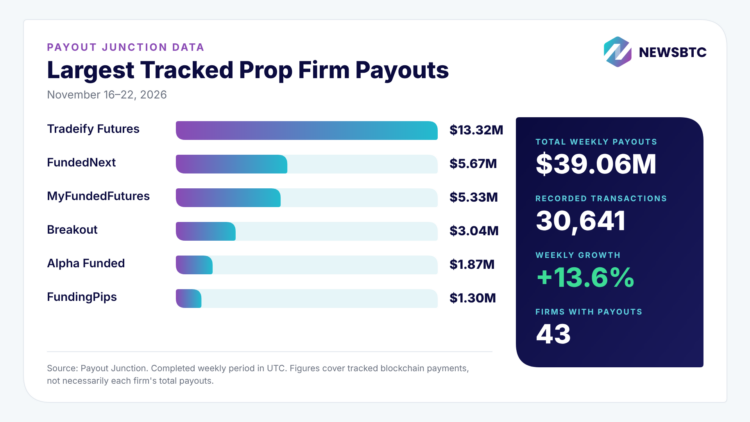
Chart by NewsBTC, data from Payout Junction, November 16–22, 2026. Tracked blockchain payments only.
Nor do the figures tell us how much traders collectively spent on challenges, resets and subscriptions before receiving those payouts.
Without that information, it is impossible to determine the industry’s aggregate profitability for traders.
Payout data is useful evidence that payments have occurred. It is not evidence that the average customer makes money.
That distinction matters when comparing the following firms.
1. FTMO — Best For Traditional Evaluation Traders

FTMO offers a conventional two-phase evaluation for traders who prefer clearly defined profit objectives and fixed overall loss limits.
Its two-step model requires a 10% profit target during the first phase and 5% during verification.
The maximum daily loss is 5% of the initial simulated capital, while the overall loss limit is 10%.
For a $100,000 evaluation, that translates into a $10,000 first-phase profit target and a $10,000 maximum overall loss allowance.
FTMO Trading Conditions
- Evaluation: Two phases under its traditional model.
- Profit targets: 10% and 5%.
- Maximum daily loss: 5%.
- Maximum overall loss: 10%.
- Funded environment: Simulated trading under contractual reward conditions.
FTMO also offers a separate one-step model. Traders should not assume that its rules are identical to the traditional challenge.
The two-step structure may appeal to traders whose strategies require more breathing room than accounts with narrow trailing loss limits.
The first-phase target, however, requires meaningful performance relative to the allowed drawdown.
Pros
- Conventional evaluation structure.
- Clearly documented trading objectives.
- Static overall loss allowance on the two-step model.
- No minimum trading-days requirement on the subsequent two-step FTMO Account.
Cons
- A 10% initial profit target can be demanding.
- Restrictions differ between account types.
- Challenge fees remain at risk if the trader breaches the rules.
Our view
FTMO is worth considering for traders with an existing, tested forex or CFD strategy. Its two-step structure is easier to assess mathematically than many trailing-drawdown alternatives, although that does not make it easy to pass.
2. FundedNext — Best For Account Model Variety

FundedNext operates across CFDs and futures, offering several routes to funded-style trading.
Its Stellar 2-Step model is particularly interesting for traders who want a traditional evaluation with relatively conventional risk limits.
The first phase requires an 8% return, followed by 5% in verification. Both phases apply a 5% daily loss limit and 10% maximum overall loss.
The published rules specify five minimum trading days per phase.
FundedNext Trading Conditions
- Representative model: Stellar 2-Step.
- Profit targets: 8% and 5%.
- Maximum daily loss: 5%.
- Maximum overall loss: 10%.
- Minimum trading days: Five per evaluation phase.
The firm also offers alternative CFD challenge formats and futures evaluations.
One area worth examining is its performance reward policy. Reward frequency and eligibility can vary according to the option selected, with some routes requiring a specific number of profitable trading days.
This makes comparing the headline profit split alone insufficient.
Pros
- Multiple routes across different markets.
- Traditional two-step model with an 8% initial target.
- Different reward arrangements.
- Detailed online help documentation.
Cons
- Rules vary considerably between products.
- Some reward options impose additional profitable-day requirements.
- Promotional benefits and account add-ons may change the total cost.
Our view
FundedNext’s strongest feature is choice. Its biggest complication is also choice. Traders should compare the funded-stage conditions of each product before deciding which evaluation to purchase.
3. FundingPips — Best For Traders Comparing Payout Options

FundingPips offers several evaluation models, including one-step, two-step and evaluation-free alternatives.
Its 2-Step Standard model requires an 8% profit target followed by 5% in verification.
The firm’s current documentation also confirms that the previous optional 10% first-phase target was discontinued on July 24, 2026.
FundingPips Trading Conditions
- Representative model: 2-Step Standard.
- Profit targets: 8% and 5%.
- Maximum daily loss: 5%.
- Maximum overall loss: 10%.
- Additional conditions: Dependent on the selected reward cycle.
FundingPips is an example of why traders must pay attention to changes in prop firm rules.
Its Standard model documentation applies a 35% consistency condition to the on-demand reward cycle.
This means a trader who generates most of their profit during one unusually successful session could need additional trading before qualifying for a withdrawal.
That might suit a strategy producing relatively steady returns. It could be less suitable for traders whose profits are concentrated around a handful of strong market opportunities.
Pros
- Multiple evaluation routes.
- Different reward-cycle choices.
- Competitive first-phase target on the Standard model.
- Extensive model-specific documentation.
Cons
- Certain withdrawal options have consistency conditions.
- Strategy restrictions require careful review.
- Older account descriptions may no longer reflect current rules.
Our view
FundingPips deserves consideration for its payout flexibility, but traders should examine the conditions attached to their preferred withdrawal cycle rather than choosing whichever option advertises the highest reward share.
4. The5ers — Best For Longer-Term Account Development

The5ers offers several forex-focused evaluation and account-development programs.
Its High Stakes program is built around a two-stage evaluation and subsequent growth opportunities.
The firm distinguishes between different versions of High Stakes, making it important to identify the exact account being purchased rather than relying on older comparisons.
The5ers Trading Conditions
- Representative model: High Stakes.
- Evaluation: Two phases.
- Drawdown: Program and account-specific limits.
- Account growth: Subject to published scaling conditions.
- Withdrawal eligibility: Dependent on the funded program.
The appeal of The5ers is its focus on account development over time.
Traders who already have a strategy capable of producing steady returns may find growth-oriented programs more interesting than accounts designed primarily around rapid evaluations.
However, scaling opportunities should not be treated as guaranteed increases in accessible trading capital.
The trader must meet the conditions attached to the program, and trading restrictions continue to apply.
Pros
- Programs designed around longer-term account development.
- Published rules for growth and profitable trading days.
- Forex-focused product selection.
- Different evaluation structures.
Cons
- Growth conditions can extend the time required to increase account size.
- Different program versions complicate comparisons.
- News-trading restrictions require attention.
Our view
The5ers is a reasonable candidate for patient forex traders who value gradual account development. Its suitability depends on the precise High Stakes version and the trader’s ability to satisfy its growth criteria.
5. Hola Prime — Best For Traders Seeking Platform Choice
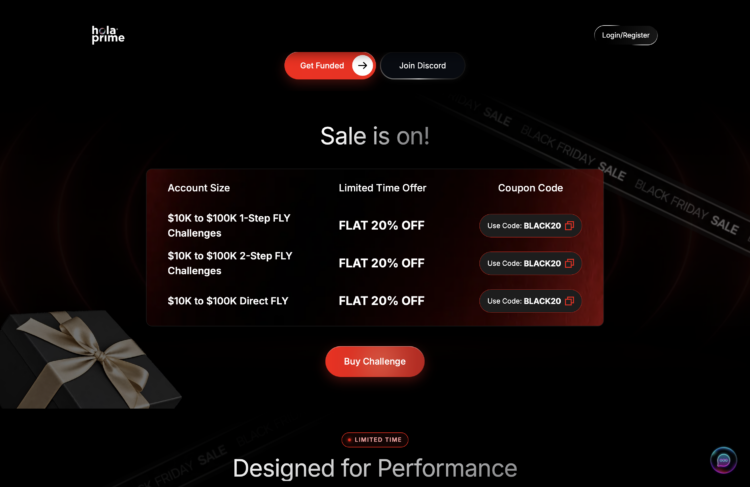
Hola Prime offers multiple evaluation formats across forex, CFDs and futures.
Its 2-Step Prime challenge requires an 8% profit target during the first phase and 5% during the second, with at least three trading days in each phase.
The firm’s published schedules also differentiate risk limits according to account size.
Hola Prime Trading Conditions
- Representative model: 2-Step Prime.
- Profit targets: 8% and 5%.
- Minimum trading days: Three per phase.
- Maximum overall loss: Generally 10%, with 8% applying to the $200,000 tier.
- Daily loss: Account-specific.
Hola Prime’s product range gives traders alternatives to the standard evaluation experience. However, account fees, platform access and withdrawal terms differ across models.
Its advertised challenge-fee refund also comes with conditions. Under the reviewed 2-Step Prime terms, the refund is distributed across the first four successful payouts rather than returned immediately upon passing.
That is an important detail for anyone calculating how much they need to earn before recovering their initial expenses.
Pros
- Multiple forex and futures programs.
- Broad platform selection across products.
- Relatively short minimum evaluation period.
- Published reference tables for account rules.
Cons
- Larger accounts can carry tighter percentage-based loss limits.
- Challenge-fee refunds require successful payouts.
- Withdrawal charges and reward conditions vary.
Our view
Hola Prime is worth comparing if trading platform choice matters to you. Just remember that a fast payout-processing promise begins after a withdrawal becomes eligible, not necessarily after your first profitable trade.
6. Topstep — Best For Structured Futures Trading

Topstep is focused on futures trading through its Trading Combine and subsequent funded-account structure.
Unlike a traditional CFD evaluation, the maximum loss allowance is relatively small compared with the advertised account size.
Its published Trading Combine parameters include maximum loss limits of $2,000 for a $50,000 account, $3,000 for a $100,000 account and $4,500 for a $150,000 account.
Topstep Trading Conditions
A trader purchasing the $50,000 option is not receiving $50,000 that can be lost while testing a strategy. The relevant initial risk allowance is $2,000.
After passing the Trading Combine, traders can progress to an Express Funded Account, which is a simulated funded-stage account.
Its payout policy includes conditions relating to withdrawal eligibility, payout limits and changes to the maximum loss threshold after withdrawals.
Pros
- Dedicated futures trading environment.
- Explicit dollar-based maximum loss limits.
- Structured progression beyond the evaluation.
- Extensive educational and support documentation.
Cons
- Narrow loss allowances relative to advertised account balances.
- Withdrawals can alter the account’s remaining risk cushion.
- Evaluation and funded-stage conditions differ.
Our view
Topstep is worth considering for futures traders who prefer a structured environment. Anyone moving from forex prop trading should first understand how dollar-based trailing loss limits differ from percentage-based static drawdowns.
7. Tradeify — Best For Choosing A Funded Payout Structure

Tradeify offers futures evaluations with different routes into funded-stage trading.
Its Select evaluation does not impose a daily loss limit during the evaluation but does apply a consistency requirement.
After passing, traders choose between Select Flex and Select Daily payout policies.
Tradeify Trading Conditions
- Representative model: Select.
- Market: Futures.
- Evaluation daily loss limit: None under the reviewed Select rules.
- Evaluation consistency: Applicable.
- Funded payout options: Select Flex or Select Daily.
The ability to select a payout arrangement is attractive because not every trader earns profits in the same way.
A trader producing relatively consistent daily returns may prefer a different structure from someone whose strategy depends on occasional larger moves.
However, the choice is permanent for that funded account, according to Tradeify’s official payout policy.
Changing to the alternative arrangement requires obtaining another qualifying account.
Pros
- Choice of funded-stage payout arrangements.
- No daily loss limit during the reviewed Select evaluation.
- Dedicated futures trading.
- Published explanations of account-specific withdrawal conditions.
Cons
- Evaluation consistency requirements still apply.
- Funded payout-policy selection is permanent.
- Drawdown and withdrawal conditions must be compared separately.
Our view
Tradeify’s Select model is particularly interesting because it allows traders to choose how they want to approach withdrawals after evaluation. That flexibility is only valuable if the trader understands both options before selecting one.
8. Take Profit Trader — Best For Frequent Withdrawal Opportunities

Take Profit Trader offers futures trading programs built around an evaluation, a simulated PRO account and potential progression to a live-market PRO+ account.
The firm published updated plan information on November 23, 2026, making older descriptions of its account rules particularly important to recheck.
Its current product announcement describes three-day evaluations, frequent PRO withdrawals and no funded-stage consistency rule under the new plans.
Take Profit Trader Trading Conditions
- Market: Futures.
- Evaluation: Single phase.
- Minimum evaluation period: Three trading days under the new plans.
- Evaluation consistency requirement: 50%.
- PRO withdrawal availability: Daily, subject to buffer requirements.
- Funded-stage consistency: None under the new plans.
The buffer is the detail traders should examine most closely.
The firm allows eligible traders to withdraw profits above the required buffer. Consequently, a trader can have a profitable account without necessarily being able to withdraw all that profit while retaining the account.
Legacy accounts may also remain subject to their original terms.
Pros
- Frequent withdrawal opportunities.
- No funded-stage consistency condition under the reviewed new plans.
- Single-phase futures evaluation.
- A route to live-market trading through PRO+.
Cons
- PRO buffer requirements must be satisfied.
- Legacy and newer accounts can operate under different rules.
- Futures-only product offering.
Our view
Take Profit Trader stands out for its withdrawal model. Traders interested in frequent payouts should still calculate how much profit must remain in the account before treating those earnings as spendable income.
9. Lucid Trading — Best For Flexible Funded-Stage Rules
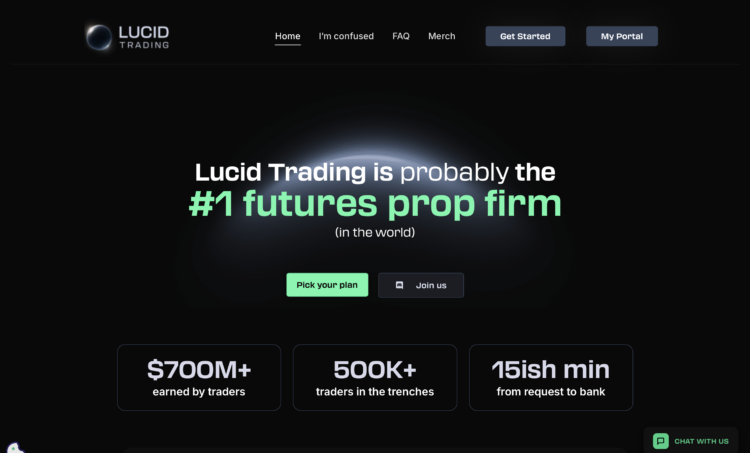
Lucid Trading offers several futures account models, including LucidPro, LucidFlex, LucidDirect and LucidDaily.
Its LucidFlex program is particularly relevant to traders who want to avoid funded-stage profit-concentration restrictions.
According to the firm’s LucidFlex documentation, the funded account does not impose a consistency rule or a separate payout buffer.
The published profit-sharing arrangement is 90% for the trader.
Lucid Trading Conditions
- Representative model: LucidFlex.
- Market: Futures.
- Funded-stage consistency: None.
- Reward share: 90%.
- Separate payout buffer: None.
- Withdrawal eligibility: Subject to qualifying objectives and account rules.
The absence of a consistency rule does not mean traders can withdraw unrestricted amounts whenever they choose.
LucidFlex still has specific payout conditions, including requirements that must be satisfied before a withdrawal is approved.
Traders must also consider how a payout affects the account’s maximum loss threshold.
Pros
- No funded-stage consistency rule on LucidFlex.
- No separate payout buffer on that model.
- 90% advertised reward share.
- Multiple futures account structures.
Cons
- Payout objectives continue to apply.
- Withdrawal caps and qualifying conditions need examination.
- Other Lucid products have different requirements.
Our view
LucidFlex may appeal to traders who dislike having their profitable sessions constrained by a consistency formula. That makes the account more flexible in one respect, not necessarily less risky overall.
10. HyroTrader — Best For Crypto-Native Prop Trading
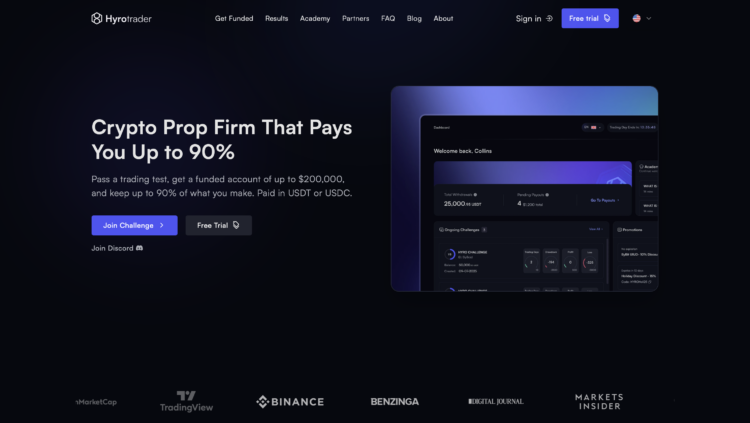
HyroTrader focuses on cryptocurrency traders rather than adapting a traditional forex evaluation to include a limited selection of digital assets.
Its one-step program requires a 10% profit target, with a 4% daily drawdown and 6% maximum overall loss under the published model.
The firm also offers alternative evaluation formats, including its recently introduced lower-cost Hyro Core program.
HyroTrader Trading Conditions
- Representative model: One-Step.
- Market: Cryptocurrency.
- Profit target: 10%.
- Daily drawdown: 4%.
- Maximum overall loss: 6%.
- Standard minimum trading days: Five on the reviewed One-Step model.
The attraction is that traders can use crypto-oriented trading infrastructure and market data rather than relying exclusively on a conventional forex platform.
For traders unfamiliar with derivatives, our guide to long and short positions in crypto explains how leverage and liquidation affect market exposure.
HyroTrader’s trading rules also clarify that allocated challenge and funded-account balances are simulated. Payouts represent a contractual share of eligible simulated trading performance.
That distinction matters because the term funded account is frequently misunderstood.
Pros
- Cryptocurrency-focused trading experience.
- Multiple evaluation options.
- Exchange-demo integration on supported setups.
- Detailed risk and trading-rule documentation.
Cons
- A 10% target against a 6% overall loss limit is demanding.
- Cryptocurrency volatility can make tight loss limits difficult to manage.
- Account-specific strategy and payout restrictions apply.
Our view
HyroTrader is worth examining for traders who already specialize in crypto markets. It is less compelling for someone whose only reason for choosing crypto is the belief that higher volatility makes a challenge easier to pass.
How The Best Prop Firms Compare By Trading Style
There is no single account structure that suits everyone.
These selections reflect specific published product features, not independently measured payout approval rates or guarantees of superior results.
The Number Most Prop Traders Should Pay More Attention To
The advertised account balance is usually one of the least informative numbers in a prop firm comparison.
Consider two hypothetical accounts:
Account A offers twice the advertised balance of Account B. Yet it provides less room for losses and requires a substantially higher profit relative to that allowance.
This does not establish the probability of passing either challenge. That depends on the strategy, trading costs, risk management and other account rules.
It does show why choosing the largest advertised account is not always sensible.
The calculation becomes more complicated when an account uses trailing drawdown.
Static Vs. Trailing Drawdown
A static maximum loss threshold remains anchored to a specified balance under the account’s rules.
A trailing drawdown moves upward as the trader generates profits, potentially reducing the room available for a subsequent losing streak.
Intraday trailing drawdown is particularly important because some models adjust the threshold based on unrealized profits.
A trade that briefly gains $1,000 before closing with a much smaller profit can therefore affect the trader’s remaining loss allowance.
Two firms advertising the same maximum drawdown can offer very different practical conditions depending on how and when that threshold moves.
Why A Profitable Trader Can Still Miss Out On A Payout
Passing an evaluation is generally only the first stage.
The rules that determine whether someone receives a withdrawal can be more restrictive than the initial profit targets.
Consistency Requirements
A consistency rule limits how much of the qualifying profit can come from a single trading session or another defined period.
For example, suppose a trader earns $2,000 during their best day and finishes the payout cycle with $4,000 in qualifying profit.
That best day represents 50% of the total.
Under a hypothetical 40% consistency requirement, total qualifying profit would need to reach at least $5,000, assuming the best day remains unchanged and the rule uses this particular calculation.
The trader may have to continue trading even though they are already profitable.
Payout Buffers And Withdrawal Caps
Some firms require profits to remain in an account as a buffer against future losses.
Others limit how much traders can withdraw during their initial payout cycles.
These restrictions are not necessarily unreasonable. A firm may want traders to demonstrate sustained performance before allowing larger withdrawals.
But customers should know exactly what they are buying.
There is a considerable difference between advertising daily payouts and allowing a trader to withdraw every dollar earned that day.
Prohibited Trading Strategies
Account agreements can restrict copy trading, certain automated strategies, cross-account hedging, account sharing, news trading and other trading behaviors.
The precise definitions differ between firms.
Before paying for an account, traders should review both the public trading objectives and the account agreement governing payout eligibility.
A strategy permitted during evaluation may have different conditions after funding.
How Much Do Prop Firm Challenges Really Cost?
The advertised challenge price is only the initial expense.
Depending on the firm and product, customers may also incur subscription charges, reset fees, funded-account activation fees, market-data fees, platform costs or withdrawal-processing charges.
Promotional discounts can make the first purchase attractive without necessarily reducing the cost of subsequent attempts.
Consider a hypothetical trader who purchases four $100 challenges before successfully qualifying for a funded account. That trader has spent $400 before accounting for any additional charges.
The first $300 payout would not mean the trader has made a net profit from prop trading.
Their total challenge expenditure would still exceed their withdrawals.
This is another reason the industry’s approaching $2 billion payout milestone should not be confused with $2 billion in net trader earnings.
How We Selected These Prop Firms
Our editorial assessment considers the following factors:
- Evaluation design: How the profit targets compare with the available loss allowance.
- Drawdown mechanics: Whether thresholds are static, trailing, intraday or adjusted after withdrawals.
- Payout eligibility: The conditions that must be met before traders can withdraw.
- Cost transparency: Challenge fees, recurring charges, resets and other expenses.
- Trading infrastructure: Supported markets, available platforms and product accessibility.
- Rule transparency: Whether current trading restrictions and account agreements are readily available.
- Account suitability: Which trading styles are compatible with each product.
The selection is based on documentary research rather than a claim that NewsBTC has personally purchased, traded or withdrawn money from every program.
Reported payouts are considered supporting evidence of industry activity, not a standalone measure of reliability.
Are Prop Firms Legitimate?
Retail prop firms generally offer traders access to an evaluation or simulated trading program in exchange for a fee.
Belgium’s financial regulator, the FSMA, has also published a consumer warning about retail prop trading programs, highlighting the risks of paying for repeated challenges.
Participants who meet the contractual requirements may receive monetary rewards linked to their trading performance. Some businesses subsequently move qualifying traders into live-market accounts.
This is different from opening a conventional brokerage account with personal deposited trading capital.
It also means traders should examine who operates the program, which legal entity they contract with, where disputes are handled and what happens if the provider changes its rules or ceases operations.
A large number of successful payout transactions does not guarantee that every valid withdrawal will be approved, nor does it establish the financial health of the company.
Before buying a challenge, traders should read the current agreement, establish their eligibility and understand which circumstances can lead to account termination.
Frequently Asked Questions
What Is The Best Prop Firm In 2026?
FTMO and FundedNext are worth comparing for traditional forex evaluations. Topstep, Tradeify, Take Profit Trader and Lucid Trading offer different futures trading structures, while HyroTrader is focused on cryptocurrency.
The most suitable firm depends on the trader’s strategy, risk tolerance, market preference and withdrawal requirements.
Which Prop Firms Have Daily Payouts?
Take Profit Trader offers daily eligible withdrawals under its reviewed PRO model, subject to the required buffer. Tradeify also offers a Select Daily payout arrangement.
Daily availability does not remove other eligibility conditions.
Which Prop Firms Have No Consistency Rule?
LucidFlex does not impose a funded-stage consistency rule under its published terms. Take Profit Trader’s new PRO plans also advertise no funded-stage consistency requirement.
Evaluation-stage restrictions may still apply.
What Is The Best Crypto Prop Firm?
HyroTrader is one of the crypto-focused firms worth researching because its programs are built around digital-asset trading.
Traders should compare cryptocurrency market access, drawdown calculations, exchange integrations and payout eligibility before selecting a program.
Can You Lose Money With A Prop Firm?
Yes. Traders can lose evaluation fees, subscriptions, reset fees and other charges without ever receiving a payout.
The simulated nature of many funded accounts does not eliminate the financial risk of paying for repeated evaluations.
Are Prop Firm Payouts Guaranteed?
No. Withdrawals depend on the firm’s contractual requirements, trading-rule compliance and ability to make payments.
Historical payout figures do not guarantee future withdrawals.
Final Verdict
The prop trading industry has grown considerably, and nearly $2 billion in tracked payouts demonstrates that substantial sums are changing hands.
What it does not demonstrate is how many traders are profitable after accounting for their expenses.
The best prop firm is not necessarily the one paying the most money, offering the largest account or advertising the highest profit split.
It is the one whose evaluation and funded-stage rules are compatible with a trader’s existing strategy.
Before purchasing a challenge, calculate how much room the account actually provides for losses, how much profit must be generated before a withdrawal becomes possible and how much repeated attempts could cost.
Those numbers are considerably more useful than the advertised account balance.