

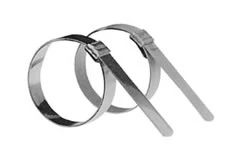

If you’re struggling to install a P-clamp, you may want to use a clamp keeper. Hose clamps play an important role in pressurized systems. Once fitted over a pressurized hose, they create a tight seal to prevent leaks. When the fluid traveling through a hose heats up, it will become pressurized. This pressure can cause hoses to leak around barbed connection points.
Installing a hose clamp, however, isn’t always easy. Depending on the style, you may have to squeeze the clamp, followed by holding it in place. If the clamp shifts or otherwise moves, it may fail to create a tight seal. Fortunately, clamp keepers are available to assist with the installation of certain hose clamps, such as P-clamps.
What Are Clamp Keepers?
Clamp keepers are retaining components that are designed to hold clamps in place during installation. They are commonly used in conjunction with P-clamps.
P-clamps are installed over hoses for support and routing purposes. Placing a P-clamp over the hose will help to support it. A clamp keeper is a simple retaining component that will hold the P-clamp in the correct position while the P-clamp is being mounted, making installation a little easier.
How Clamp Keepers Work
Clamp keepers work by holding clamps in the desired position. They aren’t a replacement for a traditional hose clamp, such as a worm-gear or spring clamp; most pressurized hoses still require a traditional clamp to create a tight seal and prevent leaks. Clamp keepers simply hold P-clamps in place.
P-clamps require a fastener, such as a bolt or screw. They typically feature a single fastener hole, which is used for mounting purposes. The fastener anchors the P-clamp, as well as the hose with which it’s used, to an adjacent surface.
Rather than trying to hold a P-clamp manually, you can use a clamp keeper. The clamp keeper will prevent the P-clamp from moving during installation.
Choosing a Clamp Keeper
You should choose a clamp keeper that’s compatible with the clamp type. Most clamp keepers are designed for use with P-clamps, which are characterized by a P-shaped design. With that said, clamp keepers are available in different sizes. Some of them are bigger and, therefore, designed for larger P-clamps than others.
Pay attention to the material when choosing a clamp keeper. Clamp keepers are often exposed to moisture and fluids. Over time, exposure to these elements can lead to corrosion. Many clamp keepers, though, are made of durable, corrosion-resistant materials to withstand such damage.


