


75% of UK recruiters believe at least half the CVs they see are AI-written. That figure comes from TestGorilla’s survey of 483 UK recruitment professionals in October 2026, and TestGorilla sells skills assessments, so it has a commercial interest in the finding. But the pattern it describes is consistent across sources.
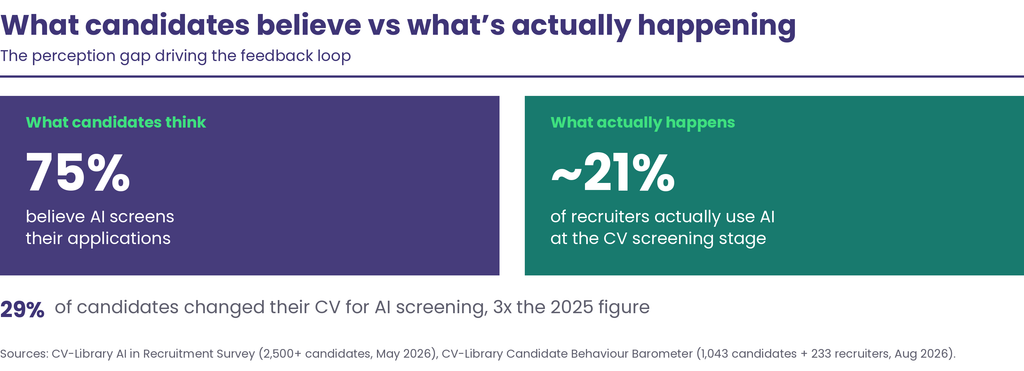
At the same time, 75% of candidates believe AI is already screening their applications, according to CV-Library’s survey of more than 2,500 UK candidates in May 2026. More than half say they don’t trust AI-led hiring decisions.
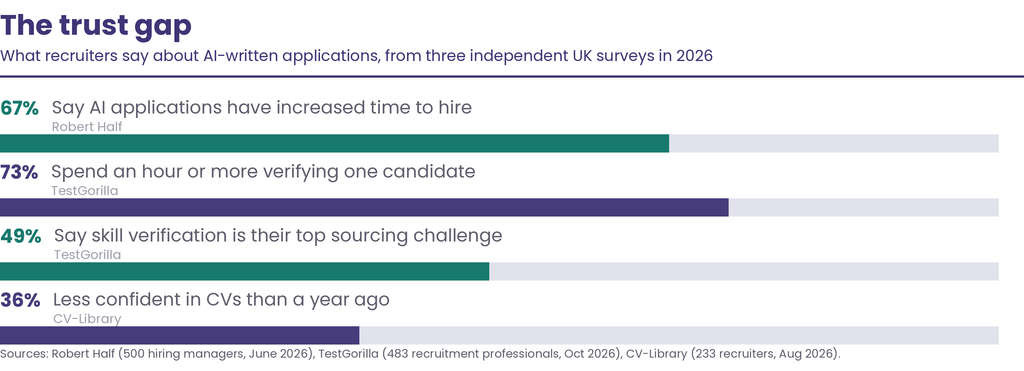
Both sides are now adapting to what they think the other side is doing. Candidates use AI to write CVs they believe AI will screen. Employers spend longer verifying applications they suspect AI has written. Robert Half found that 67% of UK hiring managers say AI-generated applications have increased the time it takes to hire.
No professional body has yet published UK data on the scale of AI-written applications. The evidence below comes from recruitment industry surveys, the ICO’s own audit findings, and peer-reviewed research on detection bias. Where a source has a commercial interest, the piece says so.
Explore: Is AI Coming for HR Jobs?, for why AI is changing HR’s role, not replacing it.
What Recruiters See
The clearest evidence of the problem comes from the people reviewing applications.
Robert Half surveyed 500 UK hiring managers and 1,000 professionals in June 2026. Among hiring managers:
- 67% say AI-generated applications have increased time to hire
- 48% say AI-written CVs are creating notable challenges for their organisation
- The most cited pain points: managing increased volume from unqualified candidates (28%), distinguishing AI-generated from authentic CVs (27%), needing extra interviews to validate skills (23%) and spending more time verifying credentials (23%)
TestGorilla’s survey of 483 UK recruitment professionals found the verification burden in sharper detail. TestGorilla sells skills assessments, so its interest in this finding is direct, but the numbers point the same way:
- 87% say candidates whose profiles claimed AI skills had demonstrated weaker skills than expected, at least sometimes
- 73% spend an hour or more verifying a single candidate’s ability to do the job
- 49% named verifying whether the skills on a CV are genuine as one of their top three sourcing challenges, the most cited issue in the survey
CV-Library’s Candidate Behaviour Barometer, surveying 233 recruiters in August 2026, found 36% are now less confident than a year ago that a CV accurately reflects a candidate’s skills. More than half cited obviously AI-generated CVs or cover letters as a factor.
What Candidates Experience
Candidates aren’t passive in this. They’re adapting too, often to a threat that’s larger in their minds than in reality.
CV-Library’s AI in Recruitment survey of more than 2,500 UK candidates found:
- 75% believe AI is already being used to screen their applications
- 53% believe they have been rejected by AI without any human review
- 52% don’t trust AI-led hiring decisions
- 63% think AI-led recruitment is less fair than human judgement
- 28% are less likely to apply to a role when AI is involved in the process
The gap between perception and reality is striking. CV-Library told the BBC that of the 425 recruiters it spoke to, only about 90 actually used AI at the CV screening stage, far fewer than candidates assume.
That hasn’t stopped candidates changing their behaviour. CV-Library’s Barometer, surveying 1,043 candidates in August 2026, found 29% had deliberately changed their CV or cover letter because they believed AI might screen it, almost three times the figure recorded in 2025.
The result is counterproductive. 70% of candidates say widespread AI use makes it harder for them to stand out. They are optimising their applications for a system many of them don’t trust, to pass a screening step that often doesn’t exist.
The Feedback Loop Nobody Planned
What happens when AI writes the applications and AI screens them is predictable: the applications converge.
TestGorilla found that one in three recruiters say every candidate profile for new AI-specific roles reads the same. CV-Library’s Barometer found 69% of recruiters agree that AI-generated applications make it harder to identify the strongest candidates.
Robert Half found only 10% of professionals say they don’t use AI in any part of the application process. The CV is now routinely written by one AI system and read by another.
Academic research cited by CV-Library warns that AI screening tools may favour AI-written CVs, not because the candidates are stronger, but because the style is familiar to the technology assessing it. A candidate whose CV has been generated or heavily edited by AI could appear stronger to a screening system built on similar language patterns.
CV-Library’s own survey found recruiters say AI performs poorly at identifying cultural fit (72%), making final decisions (70%), assessing soft skills (55%) and filtering CVs (41%). The tasks where human judgement matters most are exactly the tasks AI handles worst.
Our reading: the CV is becoming a test of prompt quality, not candidate quality. When every application is polished to the same standard, polish stops being a signal, and the document that hiring has relied on for decades stops telling employers what they need to know.
Why Detection Is Not the Answer
The instinct is to screen for AI use, and it’s the wrong instinct for three reasons.
The line between “AI-written” and “AI-improved” doesn’t exist. A candidate who uses AI to restructure a messy draft, improve their grammar or translate from their first language has not done anything dishonest. A candidate who pastes a job description into ChatGPT and submits whatever comes back has done something different.
But the output can look identical, and no tool reliably tells them apart.
Detection tools carry discrimination risk. Peer-reviewed research has found that AI text detection tools disproportionately flag text written by non-native English speakers, creating false positives that penalise candidates for how they write rather than what they know.
The EHRC has flagged concerns that AI tools in recruitment may disadvantage neurodivergent candidates, whose communication patterns differ from the norm the tools are trained on.
The regulator is already watching. The ICO’s audit of AI recruitment tools issued 296 recommendations to providers, with 97% agreed in full. It found tools inferring gender and ethnicity from names and applications, and filters that let recruiters exclude candidates by protected characteristics.
Adding another layer of AI, this time to detect AI, compounds the same risks the ICO has already flagged.
A blanket ban on AI in applications is unenforceable. It may deter careful, honest candidates who used AI for legitimate help while doing nothing about candidates who used it to fabricate.
And it creates a false sense of security: if the policy says “no AI”, HR stops looking for the real problem.
What HR Should Do Instead
The answer is to move the weight of assessment from the CV to something that works.
- Use structured checks before the interview, not just after. TestGorilla found 92% of recruiters would be willing to use an objective check before interviewing a sourced candidate. The most popular options were a short job simulation (46%), a 10-minute skills test (43%) and an ID or credential check (40%). Only 5% would proceed straight to interview with no check at all
- Design screening around evidence, not polish. Look for verifiable experience, specific examples and demonstrated capability rather than fluency and formatting. As CV-Library’s research lead put it: “increasingly polished applications mean it’s important to look beyond the CV, using interviews and skills-based assessments to understand what a candidate can do”
- Be transparent about AI use in hiring. The ICO expects employers to tell candidates how automated tools are used in recruitment and to improve how they communicate that. Transparency doesn’t weaken the process; it reduces the guesswork that drives candidates to game it
- Keep human review meaningful and consistent. The ICO found that many employers are likely relying on automated decisions without meaningful human involvement. Human review applied inconsistently, to some candidates but not others, is worse than no review at all, because it creates the appearance of oversight without the substance
- Don’t ban AI in applications. A “no AI” policy is unenforceable, penalises honest disclosure and does nothing about candidates who ignore it. A better approach is to treat the CV as one input among several and to design the rest of the process to surface what the CV no longer can
Explore: AI, Bias and Discrimination Claims and Building an AI Grievance Policy Before You Need One, for what happens when AI-influenced hiring decisions are challenged.
How Avado Can Help
Redesigning how employers assess candidates, from CV-first to evidence-first, is a recruitment and talent management skill. It sits at the heart of what the CIPD calls talent management and workforce planning: understanding labour market trends, building talent pools, and managing recruitment lawfully.
Avado’s CIPD Level 5 Associate Diploma in People Management builds that capability. Its talent management and workforce planning unit covers strategic resourcing, succession planning, and how to attract, recruit and retain the right people, including how to design selection processes that surface real capability rather than polished applications.
Explore CIPD Level 5 People Management and build the skills to hire for what candidates can do, not what AI can write!